- Original Release Date: 13 October 2008
- Developer: EA Redwood Studios
- Publisher: Electronic Arts
Summary
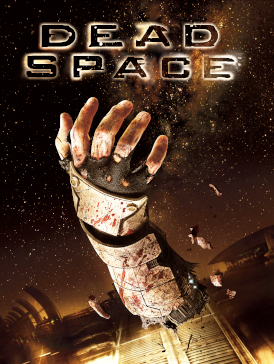
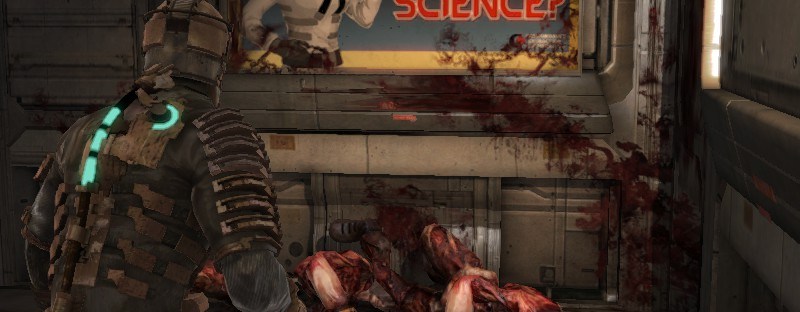
Dead Space debuted as a fresh new intellectual property in 2008. A survival horror title, the game saw the success of Resident Evil 4 in not only breathing new life into the genre but also in creating a fresh new playstyle and approach to controls. Those inspirations/influences are showcased in a title that touts the over-the-shoulder approach to the genre, while also integrating an in-game shop.
Unique to Dead Space, however, is a holographic HUD that is also part of the in-game experience. The HUD displays everything that the player might see in menus, so while the HUD is fun for when audio logs and communiques with NPCs pop up, it can make it difficult to access the inventory or the menu when the player is in a rush or in the midst of combat. I also ran into some issues while using the run button (shift) and trying to access the inventory (tab), because that same combo also pops up Steam’s in-game overlay. Yes, I died at least three or four times because I couldn’t close the Steam overlay quickly enough.
Dead Space tells the story of Isaac Clarke. An engineer who volunteered to repair a mining ship that has stopped communications, Isaac is also searching for his girlfriend, Nicole, who was aboard the USG Ishimura. From the intro, the plot of Dead Space sticks to the standard tropes of most horror science-fiction titles, owing a lot to the Alien film franchise and some other psychological films in the genre (Event Horizon comes to mind, since I watched that film near the start of the quarantine).
While I do feel like the game is partly designed as more of a straight-forward jaunt rather than something that actively promotes you to wander around and immerse yourself in the world, I nevertheless couldn’t help but feel sucked into the atmosphere of Dead Space. The twitching and shrieking monsters, the Necromorphs, are hideous and malformed/mutated corpses born from people who have died after plunging into the depths of psychological madness. Although the story of Dead Space may be littered with a treasure trove of science-fiction horror tropes, the presentation does feel like a unique spin on these ideas, rather than a tired rehashing of the genre.
Technical/Presentation (8/10)
Gameplay
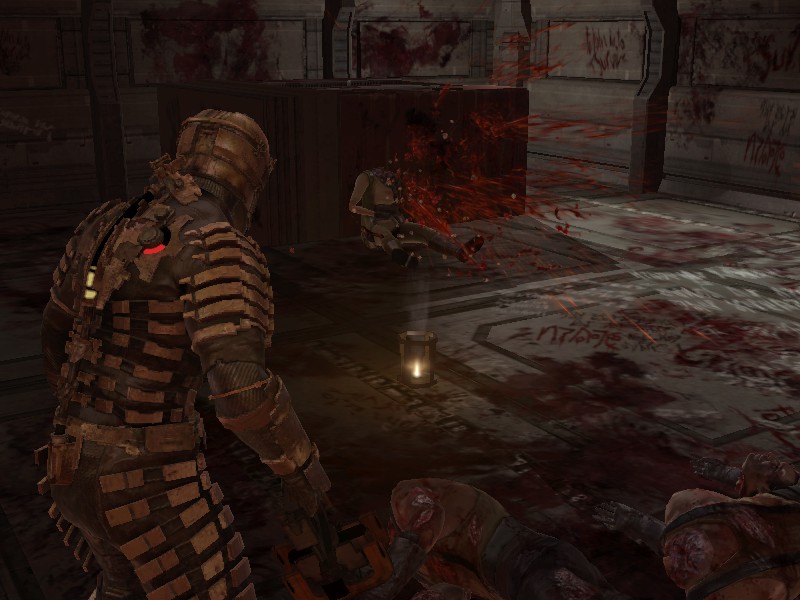
I loved this game at the time, but I’ll admit that ‘picking it up’ so many years after the fact revealed that there is some age on those bones. Dead Space 1 follows the concept that was pioneered and/or made mainstream by Resident Evil 4. That’s the idea of the whole over the shoulder perspective with targeting reticle to make aiming functional. If Resident Evil 4 was your cup of tea than you’ll adjust quickly and seamlessly to Dead Space (with one exception that I’ll outline later).
Unlike RE4, the protagonist Isaac Clarke is spaceship engineer, rather than a super-agent with unwavering sarcasm and perfect hair. Isaac moves slowly, even at a run, and I was okay with that, since he’s literally decked out in an environmental/space survival suit (dubbed a RIG in the game’s canon). He moves like a limber Big Daddy, and even his more nimble weapons still feel like they pack one hell of a wallop, likely because all of it is designed to feel like repurposed machinery or tools.
The game also matches RE4 by having an in-game shop, and aside from ammo and health, the other thing you’ll collect in gobs from murdered enemies, lockers, and destructible objects is Credits, which fills the role of standard science-fiction currency in Dead Space. You use the money at various shop stations around the ship to purchase health, weapons, ammo, upgrades to the RIG, and you can also purchase Power Nodes (which are also found as treasure), which are used to upgrade the RIG and weapons at ‘BENCH’ stations.
The only real departure from the RE4 system comes in the form of the HUD, which is a holographic projector. Anytime you hit the button to see the HUD, it appears in-world, rather than as an overlay on your PC screen. This includes video communications, text logs, and your inventory. It’s a bit jarring, and it can be frustrating in combat to try and use items but you adapt. I found that it made the map something I never used – I always had trouble angling the hologram in a way that made it quick and effective. As a result, I was never one to probe around for hidden passages that were off the quick and narrow (which is revealed by an in-game ‘bread crumb’ system wherein a button click gives you a temporary trail toward whatever your objective is at the moment.
Visuals
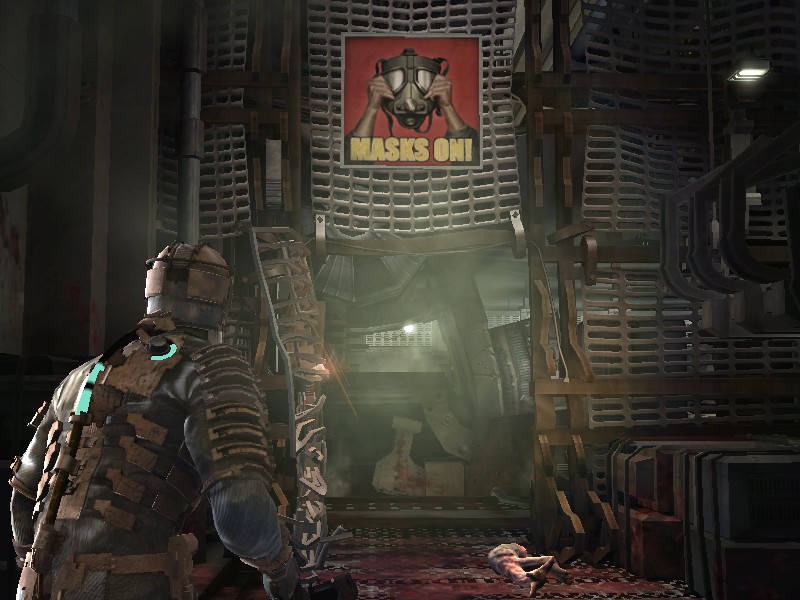
Dead Space presents all the dark and dismal confines of a derelict space ship/space station that you love to see in this genre of games. The Ishimura looks and feels much like Sevastapol Station from Alien: Isolation. There’s a lot of sparks and creaking hallways, and the fact that you’ve arrived on the Ishimura long after the war’s been lost likewise creates a lovely/horrifying variety of setpieces showcasing the rapid collapse of both society and the human mind.
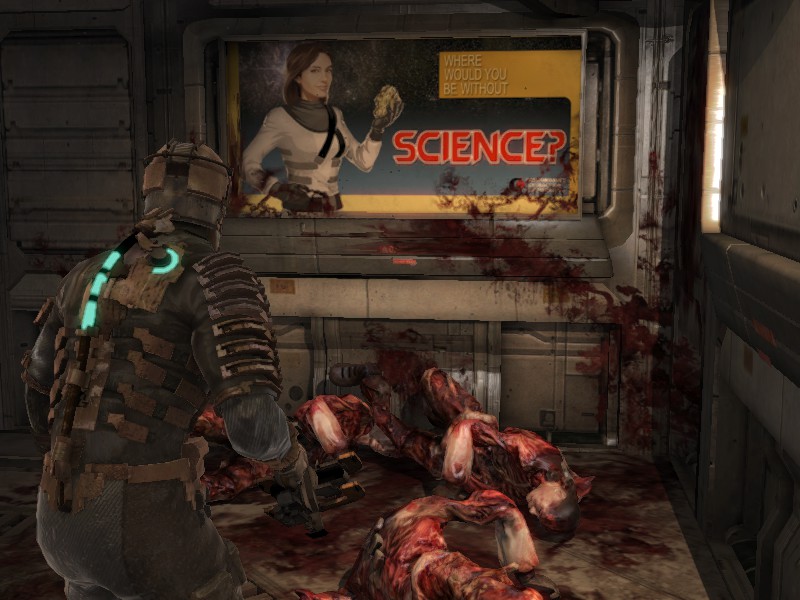
Blood scrawls adorn various parts of the ship, and as you travel throughout, you do occasionally spot survivors in various advances stages of insanity. These offer mostly just interesting audio-visual stimuli, but they also help flesh out the world around you and showcase just how horrifying the spread of the Necromorphs was on the crewmembers of the Ishimura and the colony below. Unlike Isolation, Dead Space isn’t a lo-fi setting given all the holograms and future tech, but the fact that it’s a state-sponsored mining ship does give it that layer of needed grunge.
Graphically, the game slots well into its time, and aside from NPC models that clearly feel 10+ years old, nothing looks outdated or clunky. They even remedy this by having much better NPC models for the HUD visuals. The various models of bad guys and the ways in which you can dismember them (a requirement to dispatch them most effectively!) provide fantastic visuals that help make the 100th killed enemy feel just as vindicated and worthwhile as the first dozen.
Sound
With no real soundtrack (it is a non-Silent Hill survival horror game at its core), Dead Space relies on sound effects to help convey horror and unease in the player. You hear all the skittering in the vents (a la Alien: Isolation), and there are many times where they bust out the famous horror trope of hearing voices saying or singing unsettling things from time to time. When wounded or running low on oxygen, you’ll hear Isaac labor to do simple things like running, which is a nice touch. Enemies labor and shriek as you tear them to pieces, and that adds to the visceral nature of sawing through mutated corpses with a hacksaw.
If anything, I wouldn’t have minded a few less monsters and a lot more effort taken into adding a little more spookiness to the game. It’s a horror title, don’t get me wrong, and there are steps taken to showcase the psychological nature of the monsters. Yet, I feel like they probably could have leaned more into the tension and horror but opted to create more action set pieces given that much of this feels influenced by RE4’s ‘reinvention’ of the Survival Horror genre.
Story (8/10)
The player takes on the role of Isaac Clarke, who is an engineer onboard a ship dispatched on a repair mission. In classic space story fashion, a large ship has ‘gone dark’, and Isaac volunteered for the mission because his girlfriend worked on the vessel, the USG Ishimura, a mining vessel. In this future, mining of various planets is what helped humanity ‘keep going’ after an energy crisis. ‘Planet cracking’ has become a central part of space-bound humanity’s identity, and the Ishimura was apparently one of the first large-scale mining vessels designed to ‘pop open’ planets and harvest the resources (but why is there a colony on a planet being torn open?).
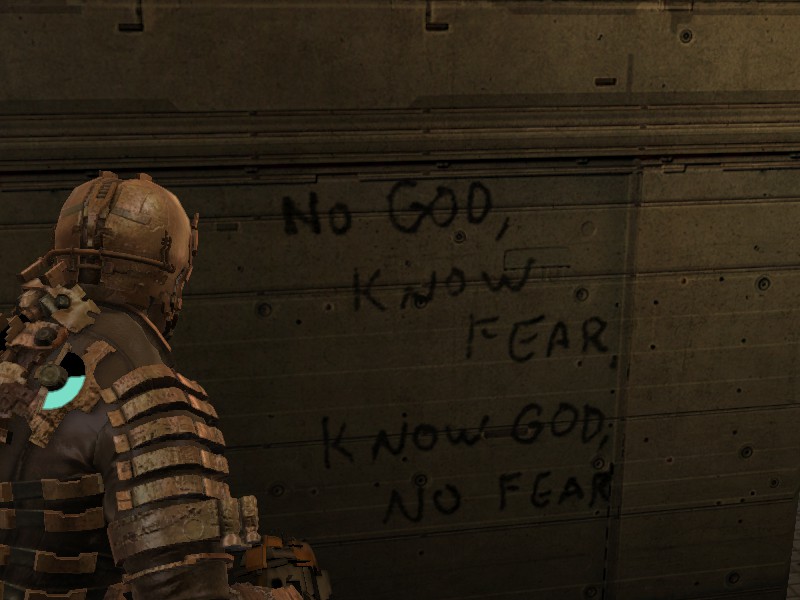
Since this is a survival horror game, the situation quickly goes very badly, and Isaac is separated from the other crewmembers of the repair ship. Fortunately, he’s inside his RIG and an engineer, so he’s able to navigate the now derelict Ishimura at the behest of the other survivors from the rescue ship—a computer specialist named Kendra Daniels and the mission’s commander, Zach Hammond.
The game that follows is broken up into various chapters, which are often bookended by visits to the Ishimura’s tram system. Isaac, with the assistance of Daniels and Hammond, navigates the ship in an attempt to get enough of it operational to ensure their survival in the short term and to figure out a way to escape. After all, they quickly discover that the Ishimura’s crew has gone insane and been overwhelmed by a disease that transforms corpses into hideous monsters (dubbed Necromorphs). Many of the surviving crew members at the time of Isaac’s arrival are too far gone to reason with, but there are various scientists that he interacts with (like Dr. Kyne and Dr. Mercer, both insane in their own way). Isaac is also able to briefly get in touch with Nicole.
Along the way, a second ship crashes into the Ishimura, and by this point, crew logs and the findings of Hammond and Daniels reveal that everything went bad after the colonists found something called ‘the Marker’, which is tied into a popular religion called Unitology. The Marker started the disease that created the Necromorphs and eventually spread up to the Ishimura. The last phase of the story sees Isaac attempting to deal with the Marker and eventually escape from the Ishimura and the doomed planet beneath.
Spoiler Zone
There are a handful of plot twists in Dead Space, and at least one of them ‘got me’ since it has been close to 7+ years since I played and finished this game.
Essentially, the Ishimura had been in the area against the instructions of its parent company. The reason for this was that they were traveling there to recover the ‘Red Marker,’ which as mentioned above is something mentioned in the guiding principles of Unitology, a religious movement that has swept across the Earth and looks amusingly similar to modern-day Scientology. Documents reveal that Unitology has various ‘levels’ that are unlocked through paying the church, much like Scientology. Unitology is built around the belief that their founder, Michael Altman (who has godlike status among believers) was murdered by the Earth’s government when he discovered an artifact called ‘the Black Marker’ that proved the existence of alien life.
When the colonists discovered a Red Marker on Aegis VII, they got in touch with the church, which told the captain of the Ishimura, Benjamin Mathius, to go there and retrieve it. A devout Unitologist, Mathius agreed, and the crew of the Ishimura was likewise filled with Unitologists or varying levels of devotion. The Red Marker caused the colony to be infected and later the Ishimura, which led to the events of the game. What is revealed near the end of the game by Kendra Daniels, who is an agent for the Earth’s government, is that the Red Marker was planted on Aegis VII by the government. The colonists were part of an experiment on the power of the Marker. It really comes down to an amusing game of trying to decipher which side is worse—the extremist religion or the government that experiments on its citizens.
The twist that was a little easier to see coming is the fact that Nichole, Isaac’s girlfriend and the sole reason he went on the mission, has been dead the entire time. The video of her that you see in the intro and that pops up occasionally throughout cut off before its conclusion, wherein Nicole kills herself with a syringe injection into her arm. The Nicole who supports you and comforts you is a manifestation of insanity brought about by the Marker. This is a little easier to spot, since Daniels mentions seeing her brother, but it’s still a gut punch made all the more worse at the end of the game, when Isaac has survived only to turn and see a bloody Nicole shrieking at him from the other chair of the escape ship.
Reflection
Dead Space is a great survival horror story that takes all the beloved tropes associated with alien life forms and ‘trapped on spaceship’ stories and ties them with a new bow. The added wrinkle involving the Unitology religion adds a spin to the story of Dead Space that helps it to stand apart from something like Alien or Half-Life. Dead Space will always slot into one of my favorite genres/sub-genres of science-fiction horror, so it goes without saying that there’s a lot that I enjoyed in this game. Like many other survival horror games, there’s a degree of the plot that you’ll uncover through audio, text, and video logs, but that additional information won’t make or break the experience. Much of it simply provides backdrop in the form of fleshing out some of the sadder stories on the Ishimura, like the ship engineer’s efforts to find his partner/girlfriend.
That said, I imagine someone who is a little less rose-tinted than me might look at these same tropes and grumble. How many times has human greed led to wanton destruction and loss of life? How many times has science been manipulated and perverted into something evil and vile? How often does the silent protagonist get separated from everyone and left to fend for themselves, with only a comm link tethering them to their partners or other survivors? Having said all of that doesn’t detract from the fresh experience that this game provided at the time, since this was a fresh IP that was clearly trying to take the RE4 style of survival horror gameplay and run with it. In that sense, I think it was a success, and much like Alien, the story here sets up for what could be a very successful IP.
Bias/Nostalgia Tint – “Three power nodes out of five”
I’ve had this game since early in my day’s of Steam, and while I always thought (and still think) these are clunkier versions of RE4 controls, it doesn’t change the fact that I am a sucker for these type of stories. Space, aliens, greed, science, and body horror are just right in my wheelhouse.
Overall: B+
Playtime
- About 10 hours (Normal Difficulty / April 20 – 21st, 2020)
Achievements
- Game predates achievements (Steam Version)
 The Terra Primus Chronicles