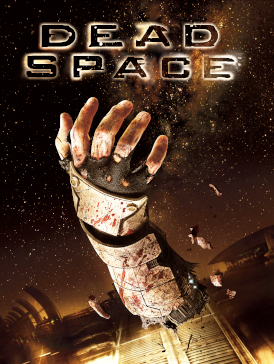
Dead Space 1

  • Original Release Date: 13 October 2008
  • Developer: EA Redwood Studios
  • Publisher: Electronic Arts

Summary

            Dead Space debuted as a fresh new intellectual property in 2008.  A survival horror title, the game saw the success of Resident Evil 4 in not only breathing new life into the genre but also in creating a fresh new playstyle and approach to controls.  Those inspirations/influences are showcased in a title that touts the over-the-shoulder approach to the genre, while also integrating an in-game shop. 

            Unique to Dead Space, however, is a holographic HUD that is also part of the in-game experience.  The HUD displays everything that the player might see in menus, so while the HUD is fun for when audio logs and communiques with NPCs pop up, it can make it difficult to access the inventory or the menu when the player is in a rush or in the midst of combat.  I also ran into some issues while using the run button (shift) and trying to access the inventory (tab), because that same combo also pops up Steam’s in-game overlay.  Yes, I died at least three or four times because I couldn’t close the Steam overlay quickly enough.

            Dead Space tells the story of Isaac Clarke.  An engineer who volunteered to repair a mining ship that has stopped communications, Isaac is also searching for his girlfriend, Nicole, who was aboard the USG Ishimura.  From the intro, the plot of Dead Space sticks to the standard tropes of most horror science-fiction titles, owing a lot to the Alien film franchise and some other psychological films in the genre (Event Horizon comes to mind, since I watched that film near the start of the quarantine).

            While I do feel like the game is partly designed as more of a straight-forward jaunt rather than something that actively promotes you to wander around and immerse yourself in the world, I nevertheless couldn’t help but feel sucked into the atmosphere of Dead Space.  The twitching and shrieking monsters, the Necromorphs, are hideous and malformed/mutated corpses born from people who have died after plunging into the depths of psychological madness.  Although the story of Dead Space may be littered with a treasure trove of science-fiction horror tropes, the presentation does feel like a unique spin on these ideas, rather than a tired rehashing of the genre.

Technical/Presentation (8/10)

Gameplay
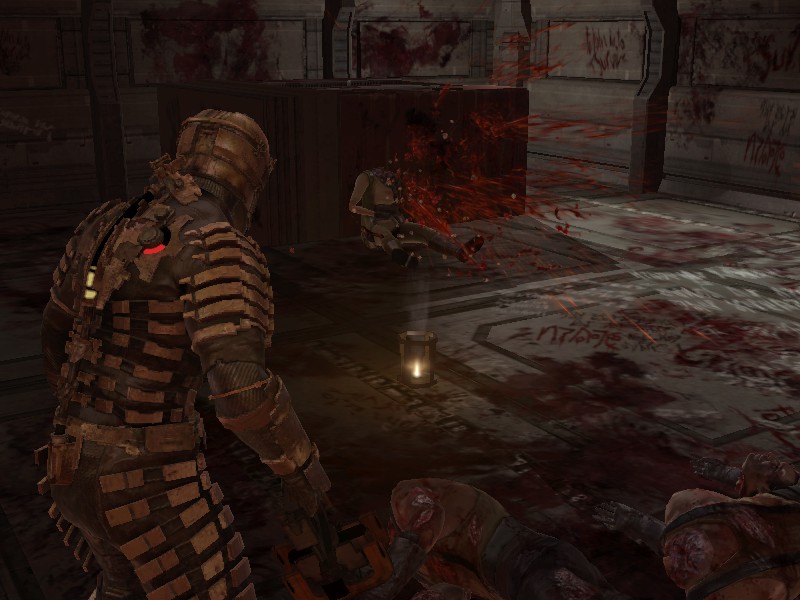
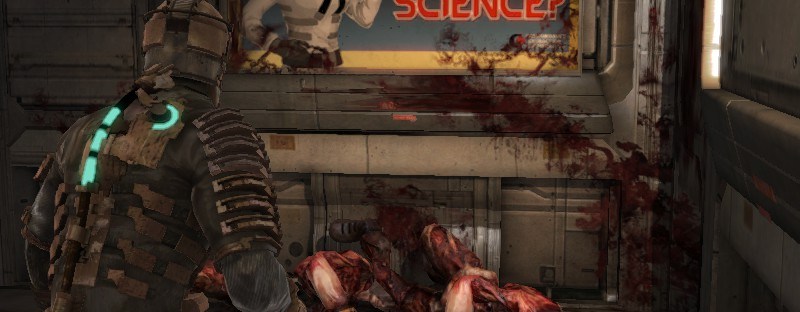
You’d be shocked to realize this game has lots of blood and gore

            I loved this game at the time, but I’ll admit that ‘picking it up’ so many years after the fact revealed that there is some age on those bones.  Dead Space 1 follows the concept that was pioneered and/or made mainstream by Resident Evil 4.  That’s the idea of the whole over the shoulder perspective with targeting reticle to make aiming functional.  If Resident Evil 4 was your cup of tea than you’ll adjust quickly and seamlessly to Dead Space (with one exception that I’ll outline later).

            Unlike RE4, the protagonist Isaac Clarke is spaceship engineer, rather than a super-agent with unwavering sarcasm and perfect hair.  Isaac moves slowly, even at a run, and I was okay with that, since he’s literally decked out in an environmental/space survival suit (dubbed a RIG in the game’s canon).  He moves like a limber Big Daddy, and even his more nimble weapons still feel like they pack one hell of a wallop, likely because all of it is designed to feel like repurposed machinery or tools.

            The game also matches RE4 by having an in-game shop, and aside from ammo and health, the other thing you’ll collect in gobs from murdered enemies, lockers, and destructible objects is Credits, which fills the role of standard science-fiction currency in Dead Space.  You use the money at various shop stations around the ship to purchase health, weapons, ammo, upgrades to the RIG, and you can also purchase Power Nodes (which are also found as treasure), which are used to upgrade the RIG and weapons at ‘BENCH’ stations.

            The only real departure from the RE4 system comes in the form of the HUD, which is a holographic projector.  Anytime you hit the button to see the HUD, it appears in-world, rather than as an overlay on your PC screen.  This includes video communications, text logs, and your inventory.  It’s a bit jarring, and it can be frustrating in combat to try and use items but you adapt.  I found that it made the map something I never used – I always had trouble angling the hologram in a way that made it quick and effective.  As a result, I was never one to probe around for hidden passages that were off the quick and narrow (which is revealed by an in-game ‘bread crumb’ system wherein a button click gives you a temporary trail toward whatever your objective is at the moment.

Visuals

            Dead Space presents all the dark and dismal confines of a derelict space ship/space station that you love to see in this genre of games.  The Ishimura looks and feels much like Sevastapol Station from Alien: Isolation.  There’s a lot of sparks and creaking hallways, and the fact that you’ve arrived on the Ishimura long after the war’s been lost likewise creates a lovely/horrifying variety of setpieces showcasing the rapid collapse of both society and the human mind. 
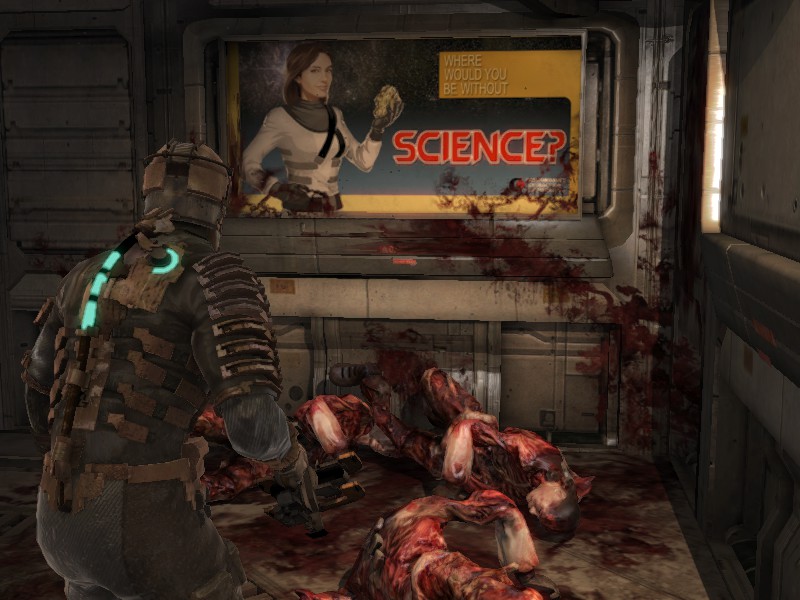
            Blood scrawls adorn various parts of the ship, and as you travel throughout, you do occasionally spot survivors in various advances stages of insanity.  These offer mostly just interesting audio-visual stimuli, but they also help flesh out the world around you and showcase just how horrifying the spread of the Necromorphs was on the crewmembers of the Ishimura and the colony below.  Unlike Isolation, Dead Space isn’t a lo-fi setting given all the holograms and future tech, but the fact that it’s a state-sponsored mining ship does give it that layer of needed grunge.

            Graphically, the game slots well into its time, and aside from NPC models that clearly feel 10+ years old, nothing looks outdated or clunky.  They even remedy this by having much better NPC models for the HUD visuals.  The various models of bad guys and the ways in which you can dismember them (a requirement to dispatch them most effectively!) provide fantastic visuals that help make the 100th killed enemy feel just as vindicated and worthwhile as the first dozen.                                                                                     

Sound

            With no real soundtrack (it is a non-Silent Hill survival horror game at its core), Dead Space relies on sound effects to help convey horror and unease in the player.  You hear all the skittering in the vents (a la Alien: Isolation), and there are many times where they bust out the famous horror trope of hearing voices saying or singing unsettling things from time to time.  When wounded or running low on oxygen, you’ll hear Isaac labor to do simple things like running, which is a nice touch.  Enemies labor and shriek as you tear them to pieces, and that adds to the visceral nature of sawing through mutated corpses with a hacksaw.

            If anything, I wouldn’t have minded a few less monsters and a lot more effort taken into adding a little more spookiness to the game.  It’s a horror title, don’t get me wrong, and there are steps taken to showcase the psychological nature of the monsters.  Yet, I feel like they probably could have leaned more into the tension and horror but opted to create more action set pieces given that much of this feels influenced by RE4’s ‘reinvention’ of the Survival Horror genre.

Story (8/10)

            The player takes on the role of Isaac Clarke, who is an engineer onboard a ship dispatched on a repair mission.  In classic space story fashion, a large ship has ‘gone dark’, and Isaac volunteered for the mission because his girlfriend worked on the vessel, the USG Ishimura, a mining vessel.  In this future, mining of various planets is what helped humanity ‘keep going’ after an energy crisis.  ‘Planet cracking’ has become a central part of space-bound humanity’s identity, and the Ishimura was apparently one of the first large-scale mining vessels designed to ‘pop open’ planets and harvest the resources (but why is there a colony on a planet being torn open?).
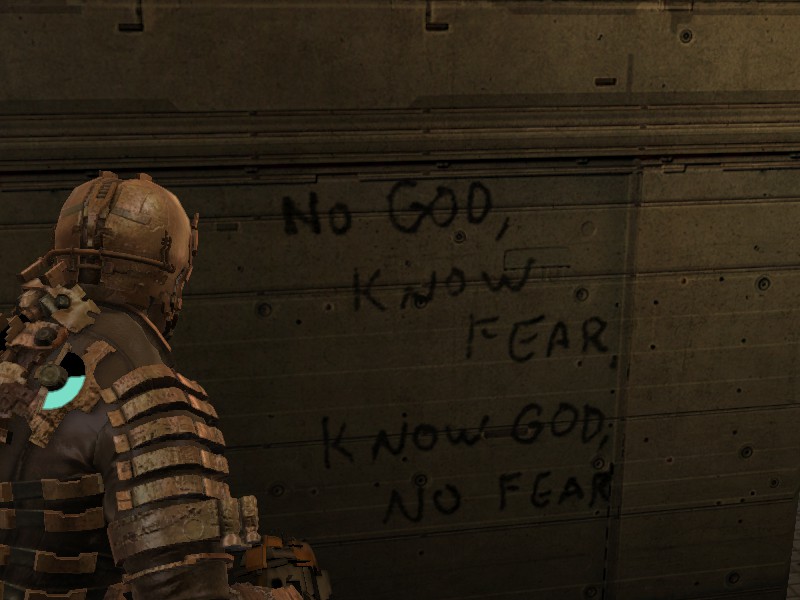
In hindsight, the storyline is fairly non-complex in the original Dead Space, especially if you play all three games

            Since this is a survival horror game, the situation quickly goes very badly, and Isaac is separated from the other crewmembers of the repair ship.  Fortunately, he’s inside his RIG and an engineer, so he’s able to navigate the now derelict Ishimura at the behest of the other survivors from the rescue ship—a computer specialist named Kendra Daniels and the mission’s commander, Zach Hammond. 

            The game that follows is broken up into various chapters, which are often bookended by visits to the Ishimura’s tram system.  Isaac, with the assistance of Daniels and Hammond, navigates the ship in an attempt to get enough of it operational to ensure their survival in the short term and to figure out a way to escape.  After all, they quickly discover that the Ishimura’s crew has gone insane and been overwhelmed by a disease that transforms corpses into hideous monsters (dubbed Necromorphs).  Many of the surviving crew members at the time of Isaac’s arrival are too far gone to reason with, but there are various scientists that he interacts with (like Dr. Kyne and Dr. Mercer, both insane in their own way).  Isaac is also able to briefly get in touch with Nicole.

            Along the way, a second ship crashes into the Ishimura, and by this point, crew logs and the findings of Hammond and Daniels reveal that everything went bad after the colonists found something called ‘the Marker’, which is tied into a popular religion called Unitology.  The Marker started the disease that created the Necromorphs and eventually spread up to the Ishimura.  The last phase of the story sees Isaac attempting to deal with the Marker and eventually escape from the Ishimura and the doomed planet beneath.

Spoiler Zone

            There are a handful of plot twists in Dead Space, and at least one of them ‘got me’ since it has been close to 7+ years since I played and finished this game.

            Essentially, the Ishimura had been in the area against the instructions of its parent company.  The reason for this was that they were traveling there to recover the ‘Red Marker,’ which as mentioned above is something mentioned in the guiding principles of Unitology, a religious movement that has swept across the Earth and looks amusingly similar to modern-day Scientology.  Documents reveal that Unitology has various ‘levels’ that are unlocked through paying the church, much like Scientology.  Unitology is built around the belief that their founder, Michael Altman (who has godlike status among believers) was murdered by the Earth’s government when he discovered an artifact called ‘the Black Marker’ that proved the existence of alien life.

            When the colonists discovered a Red Marker on Aegis VII, they got in touch with the church, which told the captain of the Ishimura, Benjamin Mathius, to go there and retrieve it.  A devout Unitologist, Mathius agreed, and the crew of the Ishimura was likewise filled with Unitologists or varying levels of devotion.  The Red Marker caused the colony to be infected and later the Ishimura, which led to the events of the game.  What is revealed near the end of the game by Kendra Daniels, who is an agent for the Earth’s government, is that the Red Marker was planted on Aegis VII by the government.  The colonists were part of an experiment on the power of the Marker.  It really comes down to an amusing game of trying to decipher which side is worse—the extremist religion or the government that experiments on its citizens.

            The twist that was a little easier to see coming is the fact that Nichole, Isaac’s girlfriend and the sole reason he went on the mission, has been dead the entire time.  The video of her that you see in the intro and that pops up occasionally throughout cut off before its conclusion, wherein Nicole kills herself with a syringe injection into her arm.  The Nicole who supports you and comforts you is a manifestation of insanity brought about by the Marker.  This is a little easier to spot, since Daniels mentions seeing her brother, but it’s still a gut punch made all the more worse at the end of the game, when Isaac has survived only to turn and see a bloody Nicole shrieking at him from the other chair of the escape ship.

Reflection

            Dead Space is a great survival horror story that takes all the beloved tropes associated with alien life forms and ‘trapped on spaceship’ stories and ties them with a new bow.  The added wrinkle involving the Unitology religion adds a spin to the story of Dead Space that helps it to stand apart from something like Alien or Half-Life.  Dead Space will always slot into one of my favorite genres/sub-genres of science-fiction horror, so it goes without saying that there’s a lot that I enjoyed in this game.  Like many other survival horror games, there’s a degree of the plot that you’ll uncover through audio, text, and video logs, but that additional information won’t make or break the experience.  Much of it simply provides backdrop in the form of fleshing out some of the sadder stories on the Ishimura, like the ship engineer’s efforts to find his partner/girlfriend.

            That said, I imagine someone who is a little less rose-tinted than me might look at these same tropes and grumble.  How many times has human greed led to wanton destruction and loss of life?  How many times has science been manipulated and perverted into something evil and vile?  How often does the silent protagonist get separated from everyone and left to fend for themselves, with only a comm link tethering them to their partners or other survivors?  Having said all of that doesn’t detract from the fresh experience that this game provided at the time, since this was a fresh IP that was clearly trying to take the RE4 style of survival horror gameplay and run with it.  In that sense, I think it was a success, and much like Alien, the story here sets up for what could be a very successful IP.
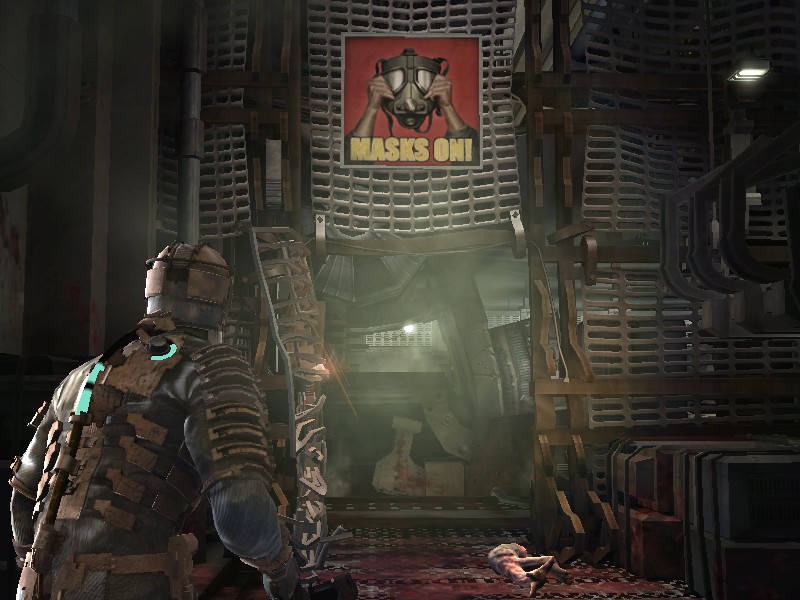
I played this at the height of pandemic time, which I imagine explains my need for this screenshot

Bias/Nostalgia Tint – “Three power nodes out of five”

I’ve had this game since early in my day’s of Steam, and while I always thought (and still think) these are clunkier versions of RE4 controls, it doesn’t change the fact that I am a sucker for these type of stories.  Space, aliens, greed, science, and body horror are just right in my wheelhouse.

Overall: B+

Playtime

  • About 10 hours (Normal Difficulty / April 20 – 21st, 2020)

Achievements

  • Game predates achievements (Steam Version)
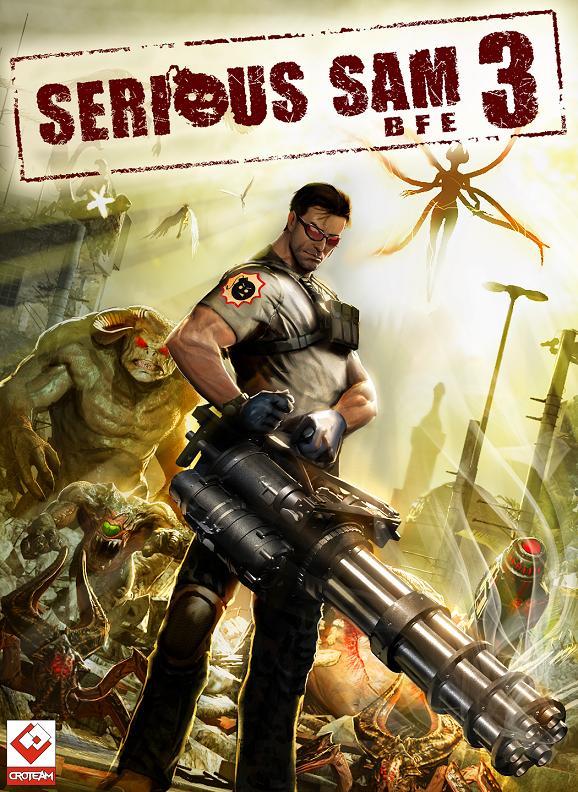
Serious Sam 3: BFE

  • Original Release Date: 22 November 2011
  • Developer: Croteam
  • Publisher: Devolve Digital

Summary

            In some franchises, the second title is often seen as a highwater mark.  My mind immediately goes to Dead Space 2 or FEAR 2—franchises who (I personally believe) peaked in many ways with their sequels.  Both of those franchises experienced dips with their threequels, although the former at least crafted an enjoyable, albeit slightly unfaithful, experience.

            With Serious Sam, you had a ‘sequel’ that looked to be an effort to cash in on a wave that had added more layers of humor to the title character through versions of the original encounters being ported to Gamecube and Xbox.  Those versions included comedic cutscenes rife with wacky humor, fourth wall moments, and slapstick, which would be amplified in Serious Sam 2.  The end result was an okay game bogged down by the aforementioned terrible qualities.

            Serious Sam 3 seems to ignore everything in this franchise that existed after The Second Encounter.  This threequel builds off the formula from the first two encounters—taking what worked and offering the addition of better visuals, sounds, and storytelling.  While the story here is a prequel (and feels a bit shorter than the other mainline titles), it nevertheless stands out as providing a pivotal chapter for fans of this series.

            A prequel, Serious Sam 3 takes nice steps to create this distinction by relying upon even more ‘grounded realism’ than the first two encounters.  Weapons all feel human, even if they still pack that same, satisfying punch that they did in the earliest titles.  The visuals aren’t as colorful, but it is still the franchise’s standard of providing you with vast, mostly outdoor areas with which to combat hordes of alien monsters.  Serious Sam 3 feels a little cramped in spots and even includes dedicated underground temple stages, but much like the vehicle sequences in the second title, those feel like welcome breaks from the occasionally ad nauseum pattern of clearing one large area and repeating the process in another.

            Serious Sam 3 should entertain fans of the franchise, whether they preferred the first two games or the sequel.  Even though the slapstick has been replaced with a more serious veneer of grit and grayed-out colors, this is still a Serious Sam experience worth slaughtering your way through.

Technical/Presentation (8/10)

Gameplay

            Serious Sam 3 ditches the majority of what was added into the second game and opts to focus on what worked the best in the originals, with one notable exception.  You’ll spent most of the game murdering everything in your path with weapons, and you’ll have a horde of health, armor, and ammo to collect along the way.  The boosters are removed, which I take to be a way for the game to be more rooted in realism, as the score feature is still maintained (I still don’t understand the point of score keeping in this game series).  The game does the benefit of outlining pickups with different colors to help see it (since the game has a lot more visual clutter, given it’s a more modern title).  There are occasionally puzzles and ‘key items’ you’ll have to collect in order to progress a stage.  Sam maintains his AI, but it feels almost prototype-like in this title—only providing visuals and some blurbs of information.

            The most distinct addition from the two original titles is the option to melee.  The melee option only works on enemies that are roughly the same size as Sam (so you can’t melee a biomech to death, but you could try with the sledgehammer, I suppose).  The melee option is fun, and it can have uses in combat—I frequently used it when I was running and had to quickly dispatch someone who was in my path and didn’t want to waste bullets or risk getting hit by my own rocket launcher.  Like Serious Sam 2, there are many boss fights in this title, and I liked that many of the earlier ‘bosses’ become stable monsters later on. 

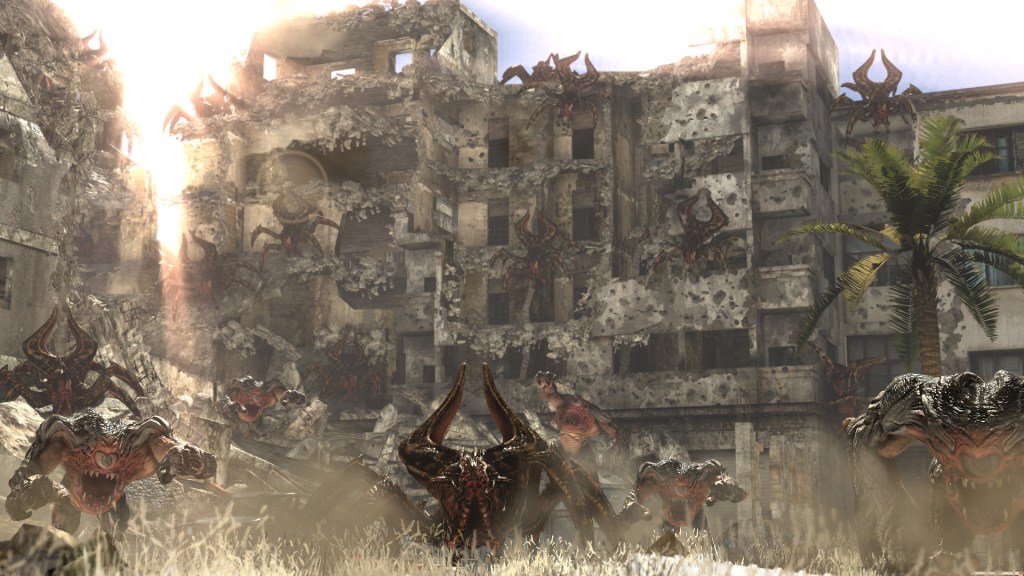
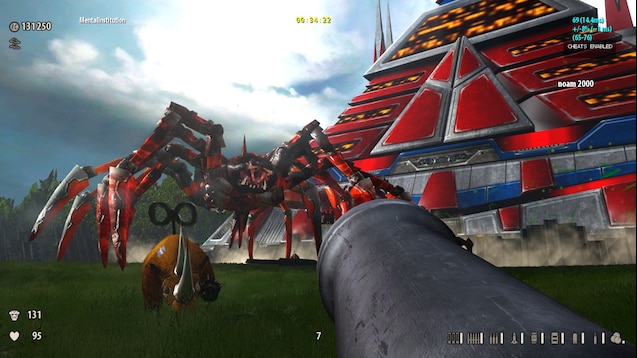
            Unlike previous Sam games, Serious Sam 3 is centered wholly in Egypt.  This game is a prequel, so it takes place before Sam left to the past, so you see a world collapsing under invasion.  Much of the set pieces are crumbled cities and the various ruins that Sam visits along the way.  There are a handful of underground segments which are illuminated by flashlight and had me thinking of other FPS titles.

            If there is one thing I can critique here (and this may apply to the series in general), the game is paced bizarrely.  Serious Sam 3, on paper, is the shortest of the franchise, with about a dozen or so stages.  Yet, some of those earlier stages are maybe under 15 minutes on Normal difficulty.  On the other hand, the last three or four stages are all nearly triple that (and likely ‘then some’, since the difficulty ramps up).  The second game had this as well—there were three 5-minute missions and then an hour-long final mission.  It was weird, and I’m sure I’m a fan of that.

Visuals

            As mentioned in the last paragraph above, the game is centered in a near future version of Egypt that has been almost entirely destroyed by Mental’s forces.  The newest game is this series that I have played, the game looks very pleasant and even shows a marked improvement over the HD remakes of the original two titles.  The cartoon nature of Serious Sam 2 is removed entirely, although at times the game almost feels too ‘grayscale’.  The original encounters had vibrant visuals in various historical settings, but the setting here feels almost like a Call of Duty game with monsters.  I do appreciate that it retains the second game’s trait of having much of the environment be destroyable, as that does help the amplify the carnage.

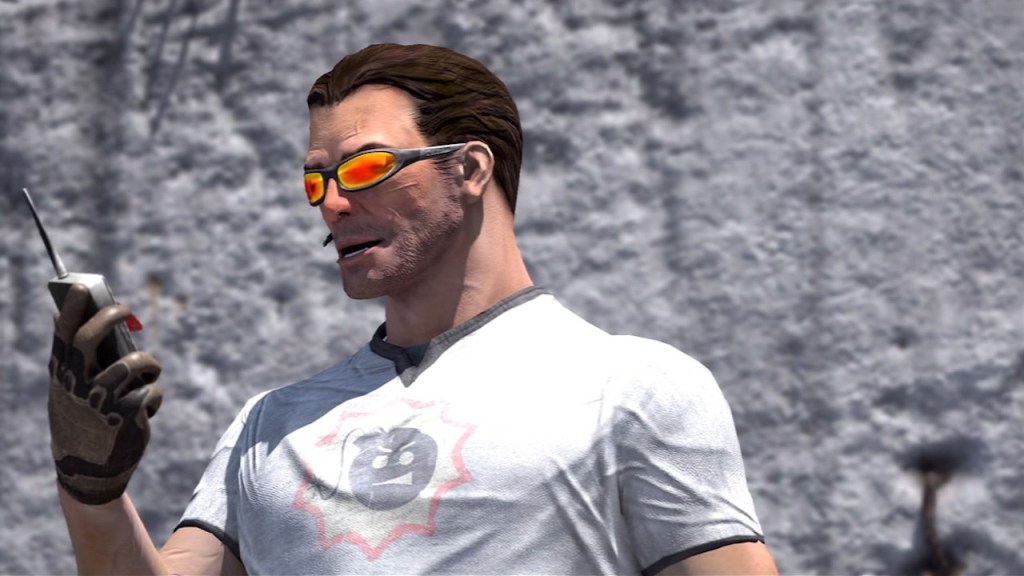
            Unlike other Sam titles, the gun selection here is toned down slightly.  Aside from the rocket launcher and the plasma gun (which you never encounter in the game outside of it being hidden in secret areas along with the sniper rifle), the weapons all feel like they could be taken from someone’s home or a military armory.  There is no whirling saw blade, laser pistol, or automatically reloading double shotgun.  An armband Sam acquires from Sirian ruins can be used to fight, but it’s a glorified melee weapon.  Since this is a prequel set firmly on a post-apocalyptic Earth, I like this touch a lot.  I also enjoy Sam’s appearance, aside from the fact that this game hasn’t quite mastered authentic-looking lips—Sam’s face looks a bit too plastic when he speaks.

            Speaking of speaking—the game includes a variety of cut scenes, but unlike the second title, these progress the story and provide far less cringe-y examples of the down-to-earth humor of this franchise.  Sam is at his best when he’s insulting aliens, swearing, or making bad puns.

Portions of this game take place in these urban environments, and I’ll admit that I got a big kick out of them.

Sound

            The sounds in this game are the best in the franchise, with the guns all looking and sounding extremely authentic.  Everything feels smoothed and polished relative to previous entries, although many of the sound effects seem to be reused from the original games (the werebull noises, for instance).

            The score in this game is fantastic.  It incorporates that thundering, heavy metal score of previous titles but cranked up to even better levels.  At many points where the music was at its most ‘extreme’, I felt like I was playing part in an Iron Maiden song or something—all thundering music and monsters.  When you couple this score with the game’s ability to emulate lighting effects and thunderstorms, it makes for an amazing field of combat.  While the improved (to PS3-gen standards at least) graphics were expected, the stellar sound and score was a nice bonus.

Story (6/10)

            Serious Sam’s first two encounters had a loose narrative guided by NETRISCA’s directions, but for the most part, Sam was by himself—one man again a horde of evil on a mission to save the future.  The second title added cutscenes, NPCs, mountains of dialogue, and slapstick, but it accomplished very little in the form of coherent storytelling given its penchant for nonsense (honestly it was like Looney Toons but with bloodshed).

            Serious Sam 3 opens with a beginning scene that is very similar to the one at the beginning of the First Encounter.  Coupled with the first stage’s Egyptian setting, I immediately wondered if the threequel was actually a remake/reimaging before realizing that this was ‘the past.’  The Time Lock hadn’t been activated yet, which meant this was a prequel that would showcase the events that led up to the start of the First Encounter.

            Serious Sam 3 succeeds with storytelling mainly because it stays… serious.  Netty is a computer AI, so the guidance is provided by a woman named Quinn at the Earth Defense Force HQ.  She guides Sam to find a professor who may have figured out how to work the Time Lock, and she later helps him navigate Luxor and Karnak to activate the technology that lay hidden beneath the sites.

            Along the way, Sam is assisted by a few helicopter pilots, and one of them, a woman named Hellfire, hints at prior past between them.  Unlike the other soldiers, Hellfire has orange shades and a more unique outfit (compared to other soldiers) like Sam.  Hellfire drops off Sam at his next location, and after a journey to the Great Pyramid, Sam heads back to HQ only to realize that the Earth is truly in the endgame of its war against Mental.

Spoiler Zone

There’s just something with this dude’s design that just makes me uncomfortable, but I’ll always enjoy my favorite not-Duke Nukem

            Anyone who has played the first two encounters knows how this story will end the moment they settle into that first level.  After activating the Time Lock, Sam is shot down from yet another helicopter.  When he manages to reestablish contact with the EDP, he learns from Hellfire that Quinn and the majority of the people at HQ were killed in a surprise attack by Mental’s forces.  She advises Sam to stock up and lay low moments before she dies off screen to a Gnaar attack.

            Realizing that he’s ‘The Last Man on Earth’ (the title of the penultimate stage), Sam sets his sights on the Time Lock.  He murders his way across a valley and through some mountains to arrive at the location of the device.  After a battle with Ugh-Zan IV (the cybernetic daddy of the First Encounter’s final boss), Sam places a call to Mental, a la both the first two encounter endings.  He gets his daughter, Judy, and Sam informs her that he’ll be coming to kill her dad.  She tells him to hurry up, as her dad is about to ‘moon’ the Earth (a throwback to something Mental told Sam at the start of the stage).

            Sam looks up and sees that the actual Moon is being driven into the Earth, so he jumps through the Time Lock, arriving at the starting location of the First Encounter.  The end credits roll over the remains of a now destroyed planet Earth.

Reflection

            Serious Sam 3 is this franchise’s first attempt (as far as I can tell, in the mainstream titles) to craft an actual narrative.  I refuse to consider anything in the second game to be coherent storytelling, so by comparison, what you have here is very good.  Sam is back to a roll where he predominately throws out insults and one-liners, and much like the original encounters, there is more good than cringe with his dialogue.  The addition of cut scenes allows for the introduction of additional characters, even if many of them aren’t destined to reach the final screen.

            The concept of making this game a prequel to the first two encounters, rather than a sequel to Serious Sam 2 seems to reinforce the notion that the developers at Croteam would rather ignore Serious Sam 2 for the time-being.  That said, the story here is a nice companion piece for the overall lore.  The fact that the Earth has already lost provides for a nice backdrop to all the murder, evoking my memories of XCOM.  Even so, the game does little to provide any real character development, and that’s including Sam.  There’s still so much of his own backstory that hasn’t actual played out in any of the mainline games, and the main villain has yet to have much development (or even a face).  That Mental is faceless for two decades will only pay off if it winds up being a worthwhile reveal.

            The fact that the fourth game is apparently going to be a prequel to this title makes sense, because it means that the developers can flesh out some of the characters introduced here (like Hellfire), while being able to showcase the actual invasion of the planet from start to (nearly) finish.

Bias/Nostalgia Tint – “Zero decapitated Kleer skulls out of five”

No previous exposure to this title; have had it in my Steam library since the earliest days of my Humble Bundle account (my second bundle purchase!)

Overall: B-

Playtime

  • 6 hours (5/4-5/5/2020)

Achievements

  • Unlocked 16 achievements on one playthrough

F.E.A.R. 3

  • Original Release Date: June 21st, 2011
  • Developer: Day 1 Studios
  • Publisher: Warner Bros. Interactive Entertainment

Summary

Do you like guns?  Do you like ducking and shooting guns?  Do you like running and shooting guns?  Did you dislike all those dark and cramped spaces?  Did you hate the all the spooky noises and paranormal experiences of the first two games?

            If so, then FEAR 3 is the game for you!

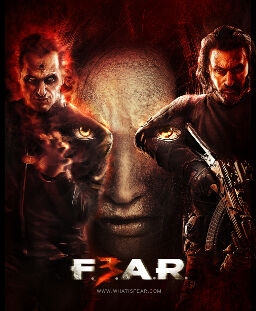
            Released a little under half a decade after its predecessor, FEAR 3 (‘F3AR’) was made by a new developer (Day 1 Studios) for reasons that I couldn’t quite dig up through a few minutes of attempted internet research.  Whether or not this hard a big effect on the game’s philosophy or not, there is a clear departure from the prior mainline entries.  FEAR 3 brings back cover mechanics, but it features very little horror elements.  Please bear in mind I didn’t think the previous titles were genuinely scary, but they still made efforts to build an atmosphere of unease and dread through environments, sound design, and occasional jump scare-esque bits.  None of that is strongly present in FEAR 3 (at least compared to the first two), which forgoes some of the design principles/hallmarks of the previous two entries to focus mostly on gunplay and co-op.

            If you’re adept at Call of Duty or any modern shooter that relies on cover to survive, you’ll get the hang of this game quickly.  For me, it took about half the game before I found a groove, but even then, the game was more challenging than the second title.  It doesn’t help that there were many occasions where I got murdered despite being in cover.

            I was unable to play multiplayer or co-op, but everything seems to indicate that they were both reasons for people to play this game on release.  Local co-op allowed two people to play as Point Man (your standard commando type with bullet time) and Fettel (a ghost with mind powers who can possess enemies) simultaneously and even compete through challenges (again akin to Call of Duty).

            In the end, FEAR 3 appears to be a serviceable co-op FPS, possibly akin to how Resident Evil 5’s multiplayer made the game less awful.  I’m unsure how popular multiplayer for it may be, but it was apparently enjoyable in that regard as well.  Unfortunately, the game falls short in furthering the ‘legacy’ of its predecessors and seemingly cares little about expanding on the grim, dark world that defined the franchise.

Technical/Presentation (5/10)

Gameplay

            Well, it goes without saying that there are some drastic… shifts from the gameplay presented in the second entry in the trilogy.  The HUD elements are vanished, along with collecting anything outside of grenades, ammo, and certain items that boost your score.  Yes, there’s a score-type system, where the game presents you with various challenges throughout each Interval.  Completing challenges boosts a score, and at certain thresholds, you will rank up and unlock new abilities and/or boosts to health or reflexes/psychic power.  Cover is a major aspect of this game, with specialized controls for maneuvering around cover, as well as peeking around cover serving as an important function.  This, combined with the leveling via mass homicide through ingenious means system makes this game feel very Call of Duty-esque.

They kept Point Man mute, and I can’t help but feel like, given how everyone else speaks and how visible he is during all the scenes, that is almost makes the game feel more comedic than intended.

            The game presents you with two characters—Point Man and Fettel.  One is the protagonist from the first game, with his slow-mo powers and access to two (TWO) weapons at a time.  Fettel can’t use weapons, but he can possess enemies and use a variety of psychic powers.  Fettel is unlocked for a level once your clear it as Point Man.  The game boosts a co-op where you and a partner can play as both characters at one time and compete to complete more challenges.  I feel like this co-op is at the heart of the game, and in many ways, it might be the best-selling point for what is otherwise a Call of Duty-style arcade shooter.

            I can’t stress enough how much of a departure this feels from the original.  You can sprint almost endlessly, and that’s coupled with the fact that your score is impacted by your time.  Along with that, health regeneration kills a lot of the suspense and dread that usually comes with spooky FPS titles.  If I can just wait until my health is full before moving on, I don’t have to worry.  On the other hand, I constantly had to worry about cover, because there were so many occasions where I would crouch behind cover and still get shot to (almost) death.  While I liked the handful of mech driving moments in FEAR 2, I thought it was a bit overdone here.  Again, it might be the fault of regenerating health, but these moments just felt like filler with close to zero stakes (like much of the game).

            Again, I unfortunately can’t comment on the co-op or the multiplayer, which I didn’t experience.  Some research told me that there’s a lot of variety there and a lot of fun to be had.

Visuals

This game looks great and has some really nice set pieces, but the actual scares aren’t as frequent as they were in previous titles

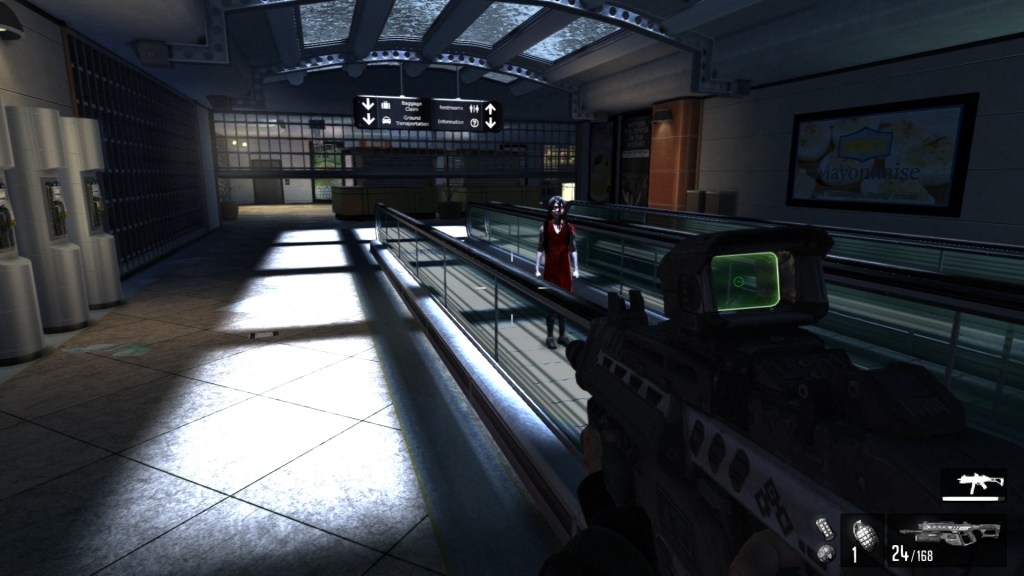
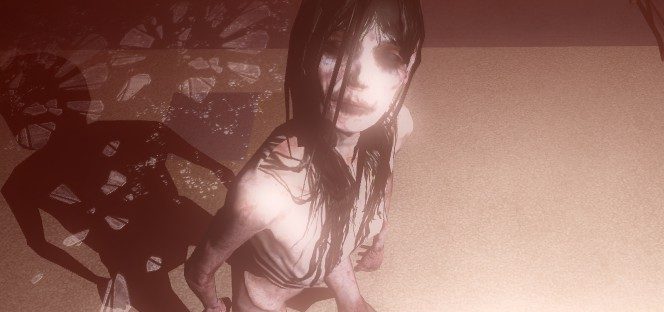
            The environment resembles what you would expect from a title in the early 2010s.  In a divergence from the previous titles, I’d wager that the majority of this game takes place in open or semi-open spaces.  Even the stages built around navigating inside tend to be large spaces (like the supermarket or the bridge) that stave off any sensation of claustrophobia that you may have felt in the first or second game.  The horror is almost entirely absent in this game.  Alma still pops up, and there’s another menacing creature that stalks you from time to time, but aside from a few subtle moments and some jump scares, there’s little horror in this title.  Occasionally, you might feel a bit of sensory overload but the horror’s gone.

            On a side note, it’s worth saying that while the environments aren’t half bad, the characters in this game look terrible (at least to me).  Something just seems off about all of them.  The proportions just seem weird… as if they were trying to make them look a little cartoony, almost.  I prefer the character designs from the first game, even if the graphics engine couldn’t render the same degree of detail. 

Sound

            The soundtrack in the game isn’t terrible, but there’s nothing that stood out to me.  For this series, that’s slightly damning, since I enjoyed the soundtrack in the original, and while the sequel wasn’t as good, it still had some nice remixes and original music.  Having just finished this game, I can’t say that anything stood out to me, because most of the time is spent running, crouching, and shooting at enemies.  I do enjoy that the enemies talk a lot more than they did in the second title.  The guns and all the other sound effects felt a bit muted, which made it a little less satisfying to slaughter people.  As the focus is more on action and less on horror, the title also doesn’t do quite as much with environmental noises, outside of the supernatural occasionally screaming or throwing stuff around.

Story (4/10)

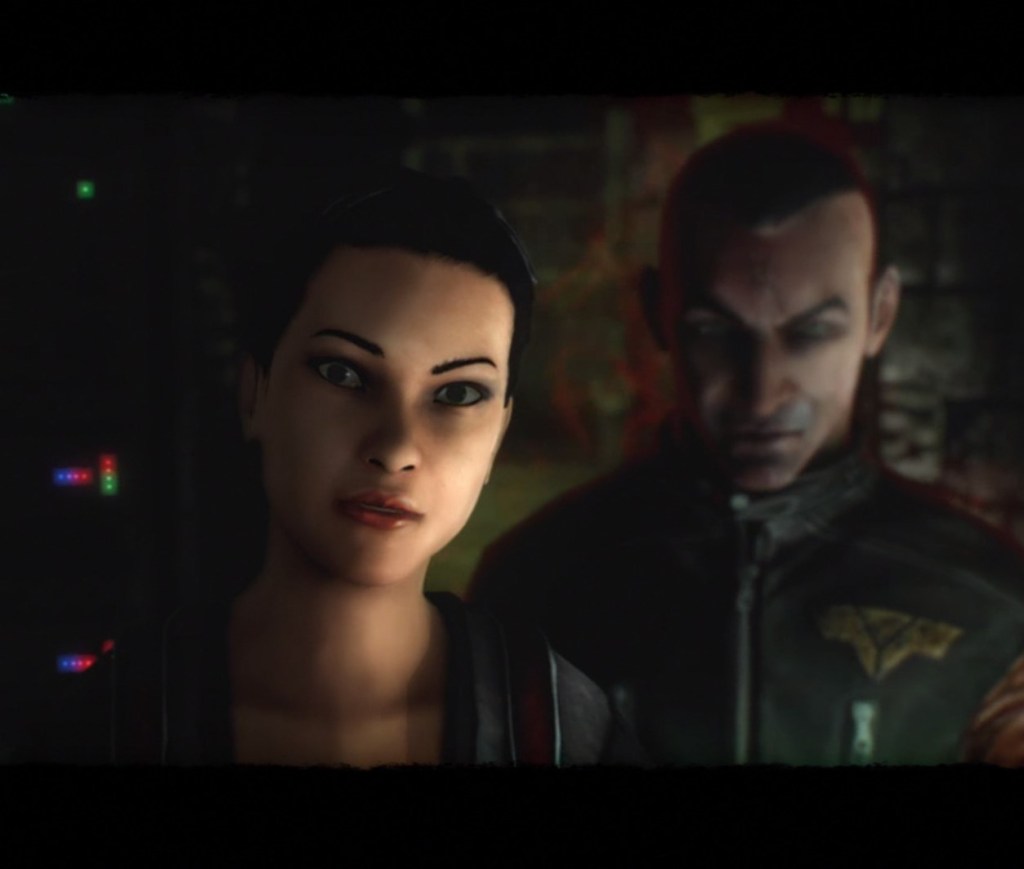
            The plot of this game is awful, both in terms of the pacing and the overall satisfaction of the story.  The story of FEAR 3 opens up about eight or nine months after its predecessor with the Point Man (the protagonist from the original game) in a prison.  He is rescued by his brother Paxton Fettel, who one of the main antagonists in the first game.  The two don’t trust each other but agree that they need to head back to Fairport, the setting for the first two games.  Fairport is still the center of a paranormal clusterfuck, and Armacham is still working very hard to cover up their mistakes that led to the whole city being ruined and its populace either dying or degrading into mindless lunatics.

Returning characters! All that fresh continuity!

            The brothers get in touch with Jin Sun-Kwon, one of the survivors from the first game and a squadmate of the Point Man.  In a brief reunion, she points (some humor) Point Man in the direction of Michael Bennet—the second game’s main character—who is being taken away by Armacham security.  Bennet apparently had a very unpleasant (for him) run-in with Alma, the series’ iconic scary ghost girl/woman.  After losing Bennet, the brothers murder there way to Bennet and then onward to Alma, where they are able to resolve form long-standing issues with their father, the late Harlan Wade.

Spoiler Zone

            I’m not sure why they took the Point Man to Brazil, but they did.  After being confused why the people were talking in not-English, a Google search told me they had taken him to Brazil rather than just killing him.

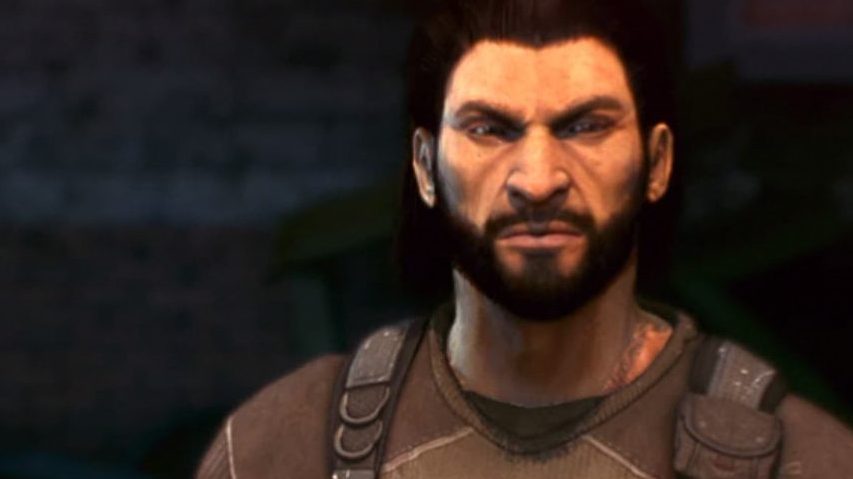
             As I mentioned above, the plot is just awful, and I believe they exacerbated that by removing lore objects from the game.  The closest thing this game has to story building are the occasional comments/witty retorts from Paxton Fettel, who is this game’s version of the Cheshire Cat and evil conscious.  He has a Vegeta-tier widow’s peak to complement the perma-scowl and cave man appearance of his brother, the Point Man.  Despite having a face, the Point Man uses it to only scowl, as he has no spoken dialogue in the game (I believe that his child version doesn’t speak either).  They don’t state if this is something intentional or not, but I can’t believe he’s incapable of speech, since he was apparently in the army before the events of the first game.

            Anyway, there’s very little story that unfolds across the game, which is shorter than the original or the sequel.  The game does have narration and cut scenes, but these are almost entirely used to showcase the pair of protagonists as children.  There’s allusions to other stuff going on, but it’s hard to tell how wide-spread the situation in Fairport is/has become.  Is it global?  Is it regional?  Is it just this city?

            As I’ve mentioned in prior reviews for the series, it was hard for me to really villainize Alma (with the exception of the end of the second game).  In this game, she’s pregnant, and her contractions are the source of much of the psychic disturbances across the various stages.  The two characters are going to find their mother.  Along the way, they locate Becket, who doesn’t offer anything new to the player before getting exploded as a by-product of Fettel possessing him. I felt a bit bad for Becket, who earlier in the game was on the edge of lunacy over being raped by a psychic ghost.  There’s nothing given to explain how he was rescued/extracted, and you don’t hear about the fate of Aristide.  If her plan was to contain Alma, she seems to have failed.  Even so, Alma is little in this game beyond Young Alma popping up in mostly non-threatening moments. 

            There’s a generic faceless monster-looking creature that serves the purpose of jumping the player (like Alma in FEAR 2), and you later discover that this is a psychic manifestation linked to memories of Harlan Wade.  It isn’t that he’s still alive, but the memories of him have coalesced into this sinister monster that scares Young Alma and threatens the protagonists until they kill it as the final boss.  Then you get an ending based on which brother had a higher score.  As I did single player as Point Man, I got the ending where he kills Fettel again, saves the baby, and watches Alma vanish.  Fettel’s ending has him possess Point Man, take the baby, and devour Alma for ‘unlimited power’ I imagine.

Reflection

            In many ways, this game feels like a major disappointment for this franchise.  The story is barebones, with little additional information to uncover and little done to flesh out this collapsed/post-apocalyptic city.  This game was 100% not designed to be an engrossing single player experience, and that much is clear from the variety of decisions made in regards to central gameplayer mechanics.  There are no new characters in this game, and the characters that are throwbacks to the previous titles feel almost more like fan-service or plot dumps (look, its Jin! Hear her tell you what to do next!  Okay, now she’s gone again) than actual people.  It doesn’t help that the game stripped out all the horror and foreboding environments from the first two games.  The ending itself adds a nonsensical cherry on top.

Bias/Nostalgia Tint – “Zero ghost babies out of five.”

            This was my first exposure to this game in any sense of the word.

Overall: C-

Playtime

  • 5 Hours (4/11-4/12/2020)

Achievements

  • 13/50 (26%) in one playthrough

Serious Sam 2

  • Original Release Date: October 11th, 2005
  • Developer: Croteam
  • Publisher: 2K Games

Summary

At some point after the release of Serious Sam: The Second Encounter, the people at Croteam apparently got experimental with how they wanted to approach the series.  Either that, or you can ‘blame’ the precense of new publish 2K Games for pushing the developers to make the game a little more cartoony and a little less serious (pun intended).  This makes some sense, when you see that the original two games have been remade ‘twice’ (an HD remake and then a VR version) and the second game isn’t even included in ‘Serious Sam Fusion’.  In my mind, it’s probably a little bit of both, since Croteam did create the spinoffs that predated Serious Sam 2.

            That aside, Serious Sam 2 is a bizarre game that I can’t say I totally enjoyed.  Is it a bad shooter?  No, of course not.  If you came to this game wanting to blast apart hordes of monsters with big guns, you came to the right place.  If you were expecting a great sequel to the first two games, you did not, because Serious Sam 2 jettisons a lot of the ‘serious’ aspects of those games (monster and environmental design) and turns it into cartoon parody, with nonsensical monsters and levels that are ridiculous and often living parodies (like an entire fairytale kingdom land ruled by Elvis). 

            While Sam in the first two games spouted one liners from time to time, and his AI often had snarky text quips, this game turns Sam into something ripped straight out of a British cartoon from the 1960s.  At first, I was mildly entertained by this, but it wears on you after many hours of various, one punchline cutscenes and ham-fisted pop culture references.  I remember thinking to myself, about 8 hours into the game, that ‘I am shocked there hasn’t been some Benny Hill gag.’  Without providing any spoilers, something close enough to said gag took place in the end credits.

            In terms of gameplay, the game sees almost all the standards of the first two titles kept, and it adds vehicles, grenades, and the random ability to pick up and throw certain objects (useless in combat but used for finding secrets).  In the end, I can see that there is some value in this game, if you can get past the needless slapstick and cartoon goofiness.  It makes sense to me that this game has seen zero sequels (Croteam’s titles since then have been spinoffs and prequels, apparently).

Technical/Presentation (6/10)

Gameplay

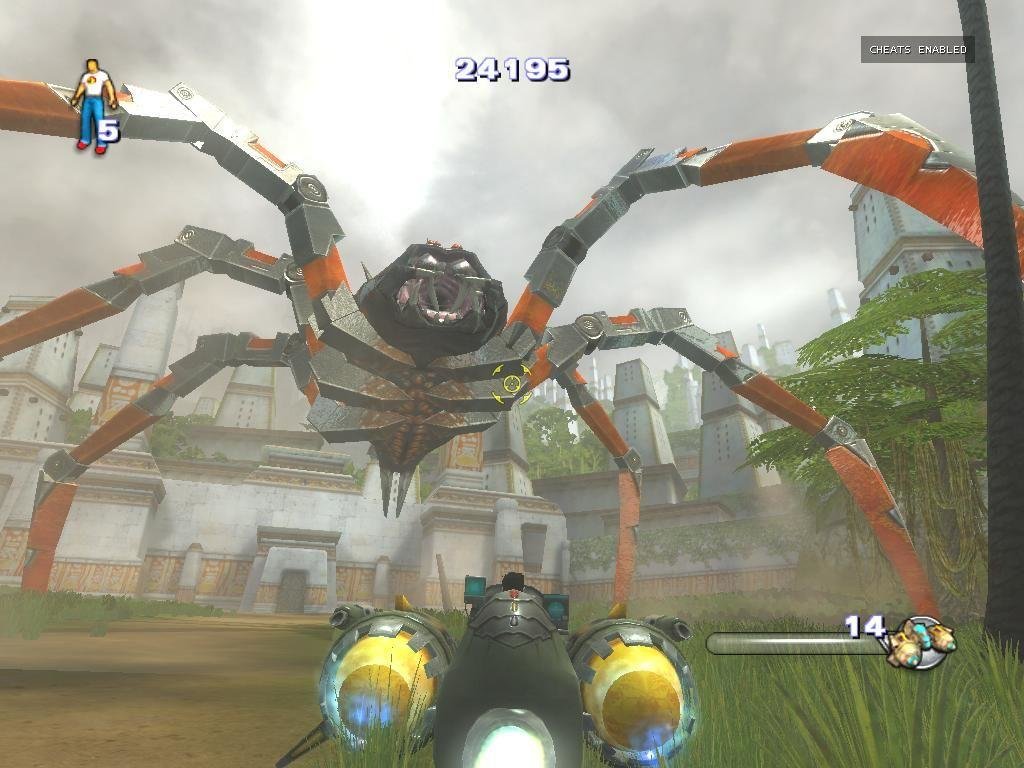
            Serious Sam 2 retains the structure of the original game, including the boosters and some of the platform elements from the Second Encounter.  There aren’t any real puzzles in this game (like the first two), but like the originals, you’ll have a few stages where you have to collect X number of items or find a switch or something to open up the next area.  Serious Sam 2 keeps the same gun designs (although they are styled differently) and adds grenades as a stand-alone button (fantastic).  Vehicles are also present in various levels, and I personally liked these segments, because they offered a different approach to the normal grind of ‘fight the hordes.’

Stuff like this isn’t awful, despite my aversion to vehicle segments in FPS games

Visuals

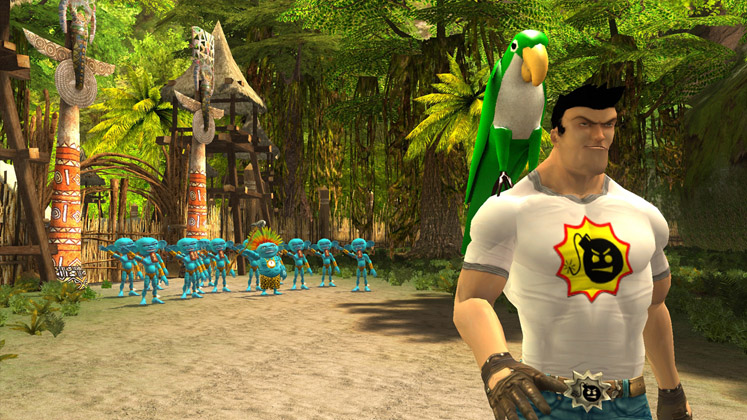
            Serious Sam 2 continues the tradition of having bright, wide-open areas for its levels, and the dial here is genuinely turned up to eleven.  While the first two encounters were centered in historical areas, Serious Sam 2 takes Sam to 7 different celestial bodies (six planets and a moon).  Loosely, you can define these as:  ‘Africa-like area, swamp, East Asia-like area, lava planet, snow planet, and sci-fi city).  Unlike the originals, you run into a variety of NPCs, and while I originally felt it strange how empty (outside of enemies) the original two games felt, I quickly grew tired of the goofy natives and their bobblehead-like designs.  They babble and occasionally talk, and it sounds like the dialogue (even the women) is the work of one or maybe two dudes.

Yes, this is a Saturday morning cartoon FPS

            The enemies in the game feature only a few returning monsters, although there are many that are similar to creatures in the first two encounters.  All of the monsters in the game are comedy set-pieces, and even the monstrous ones are usually comedically designed (the devil monsters feel like cartoon versions of Doom beasts).  The Beheaded Kamikaze from the original, which gave me conniptions, have springs for necks and serious bombs for ‘heads’.  It’s all just a bit bizarre, especially since the first two games, while peppered with ‘Duke Nukem moments’ still have a very grounded setting (although the settings in the originals were open, light, and colorful for the most part, unlike many prior FPS titles).

            Different from the originals, this game also features a bunch of weird ‘arcade’ elements.  There is a score tracker and a life system, with the game giving a pseudo game over when you run out of lives.  The penalty?  Your score gets frozen for the current stage.  I read this originates, like the cutscenes and more cartoon theming, from the Xbox remake of the original two episodes.  It feels tacked on and pointless, honestly.

Sound

           The soundtracks in this game aren’t bad, although there’s little that stood out to me.  Like with ‘the Second Encounter,’ I really started to enjoy the soundtrack near the end of the game, where they shifted to a more industrial, heavy metal track.  That aside, the sound design is straight derp, much like the monster and character design.  Guns sound normal, albeit unimpressive, but for instance, the kleer skeletons make sounds akin to hitting bowling pins when they die.  It’s not terrible, but it was just another instance of the game abandoning the more grounded settings of the first two titles for more slapstick.

            I’ve said it earlier and will likely say it again, but the voices in this game are terrible.  Aside from Sam, I think the other voices were done by two men trying their hardest to put on goofy accents or talk in high-pitches or babble-speak.  The dialogue is mostly limited to jokes, and while Netty has a dedicated voice actress, she has limited function outside of directing you where to go.

            I would expect this degree of goofiness and slapstick in, say, Conker’s Bad Fur Day, but it feels out of place in a Serious Sam sequel.

Story (4/10)

            Serious Sam 2 opens up with our hero, after the events of the first two encounters, being snatched up by a trio of siblings who have the look of cosmic beings.  There’s a lady with a weird voice and two old men with Jewish accents (not sure if this is exactly what it’s supposed to be, but they reminded me of Tommy Pickles’ grandpa).  They theorize that Sam is ‘the One’ (the first of many explicit and occasionally cringey pop culture references in this game).

            The mission is that Sam has to travel to five different worlds to recover the pieces of a medallion that can supposedly harm Mental, the overlord of the army sweeping across the galaxy.  The mission will take Sam to various worlds, where he will have to assist various bobble-headed locals (who are often caricatures of various cultures) and defeat several bosses.  These include a giant gorilla in an African-themed world, an obese Asian-styled ‘prince’ with a taste for cannibalism, a dragon who has kidnapped a hideous princess, a Kleer warlord, and a large bee.  Along the way, Sam is helped by Netty (NETRISCA), his AI from the previous game who is now able to speak with him.

            After reuniting the medallion, the three mystics (who are revealed to be living in a plain cabin) send Sam to a moon above Planet Sirius, the home of Mental.  Sam raids a prison, saving many of the locals from earlier in the game, and he shoots a laser at the planet.  He escapes to the surfaces but is tricked and apprehended.  He manages to escape once again with the help of ‘the Alliance’ (the resistance), and he goes to confront Mental at his pyramid.

(the final boss of this game is a pyramid)

Spoiler Zone

            Uhh, I can’t imagine there are really that many spoilers to be had in this game.  Really, the biggest spoiler to be had is the ending, where Sam is once again evaded by Mental.  Throughout the end credits, voiceovers express confusion that this is the end of the game, and a preceding cutscene showcases that the medallion Sam fought to create is one of many that the three mystics have in their cabin.  Over the course of the game, there are a variety of secrets, and while I stumbled onto a few of them, most of them are just extra stuff.  One spoiler involved a phone booth and receiving a call from “Sam in Second Encounter”, and since I’m fairly certain I remember seeing a phonebooth in the medieval stage, I liked that connection.

Reflection

            The ending, like much of the game, is a natural extension of the slapstick that is rife throughout this game.  The addition of more voice acting isn’t terrible, as Netty speaking winds up being pleasant after a while.  The ‘humor’ in the game is simply too much, and I think a big part of this is because it permeates nearly every aspect of the game, not just the dialogue.  As mentioned above, the humor filters into the art style, stage design, supporting cast, and enemy design.  All of the NPCs in this game are just awkward to look at, with alien-esque features but also sporting tropes from various cultural places on modern Earth, like the planet inspired by East Asian cultures where you fight kung-fu zombies and floating, cross-legged sensei-types.  The fairytale world is ruled by a king who is literally an Elvis parody.

            There are portions where the humor did make me chuckle.  The ugly princess made me laugh, as well as many quips from Netty.  The fact that I think all the NPCs were voiced by like, one dude who would do falsetto tones, likewise detracted from my enjoyment of this game.  I like to quip about ‘FPS games with stories’ and ‘those without.’  The first Sam games were plot-lite, but I think those were better experiences.  At first, I smirked at how goofy this game was – it reminded me of the humor in those old Black & White games (and British slapstick in general), but when every cutscene is a punchline (including bosses), it wore out its welcome.

Bias/Nostalgia Tint – “Zero cringy jokes out of five”

            No previous exposure to this title; have had it in my Steam library since the earliest days of my Humble Bundle account (my second bundle purchase!)

Overall: C-

Playtime

  • 12 hours (4/30-5/2/2020)

Achievements

  • Game has no Achievements/predates Achievements

F.E.A.R 2: Project Origin

  • Original Release Date: February 10th, 2009
  • Developer: Monolith Productions
  • Publisher: Warner Bros. Interactive Entertainment

Summary

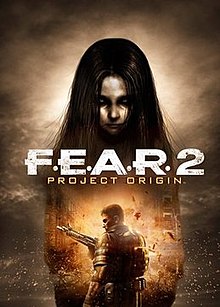
FEAR 2 is a sequel to a game that, despite me thinking it some kind of sleeper title, was a “Best of…” winner for many publications.  The original even scored in the high 80s and low 90s  (the PC version, at least), so the original had some splash when it came out.  After two expansion packs that provided a ‘more of the same’ experience, the sequel dropped roughly four years later.

One thing I learned after completing this title is that it was designed with consoles in mind.  As I mention in the more verbose portions below, I believe that ideology may have led to a bit of streamlining in the game design.  This isn’t to say it’s a shallow title, as I actually prefer the sequel to the original, but I can recognize that there may be components missing here that fans of the original may have raged about on release.  Elements like tilting are gone, and there are additions like the in-game PDA which houses lore and tutorial information.  You can, however, interact more with objects (pushing and knocking around heavy objects as cover). The worst thing, however, is that the enemy AI feels almost dumb in this game, and that makes combat a lot less tense.  This opens the game up for more horror elements, but depending on what type of person you are, you may hate the shift in emphasis.

The game is a little brighter than the original, but I liked that, because they populate the environment a lot more in this game—at least in terms of the abandoned city block segments.  I believe the biggest knocks I can have here are a lackluster use of sound (relative to the original title), and the fact that the game is almost too easy on the standard setting.  I don’t attest to be an FPS master, and the original FEAR game had me dying every now and again.  I believe, in my entire playthrough of FEAR 2, that I died maybe twice in gun combat, with a few other deaths from poorly placed grenades.

The story here starts as a side tale, with the first chapter running alongside the last Interval of the original.  From there, it takes you on a journey that further fleshes out some of the characters and buzzwords mentioned in the first title, all the while building up to one of the weirdest and most unsettling endings I’ve seen in an FPS title.

All said and done, FEAR 2 might be a step back for some who preferred the heavier focus on gunplay and dark environs of the original.  In my mind, the bit of streamlining, while it made the game a bit too easy, made for a slightly better experience.

Technical/Presentation (6/10)

Gameplay

It’s similar but different relative to the first game. While it follows the same concept of murdering your way through mostly tight quarters, collecting lore pieces, and avoiding scares, they rejiggered the control scheme a little bit.  The biggest thing that stuck out to me was that they made the flashlight the F button (and not the X button).  The first game was very dark a lot of the time, and my hand just could never pull off that slide during combat.  The ‘use’ button is now E, which means that this game got rid of the tilt/lean from the original.  I can’t say I was heartbroken by that, since this game doesn’t really need that feature (FEAR 2 is easier than the original).

The biggest departure/addition is that lore comes in the form of collectable objects that are uploaded to a PDA (which is in the protagonist’s helmet/augmented reality glasses).  Objects you can collect (lore, ammo, health, armor, boosts, etc) are outlined by the protagonist’s HUD, so it’s easier to track things, although the game tells me I still missed about a third of the lore objects.

I read somewhere that this game was designed for consoles, and while it doesn’t stick out like a sore thumb, it definitely made some of the small changes make sense to me when I learned that.

Visuals

I admittedly have a soft spot for post-apocalyptic cityscapes (as well as during-apocalyptic cities) c

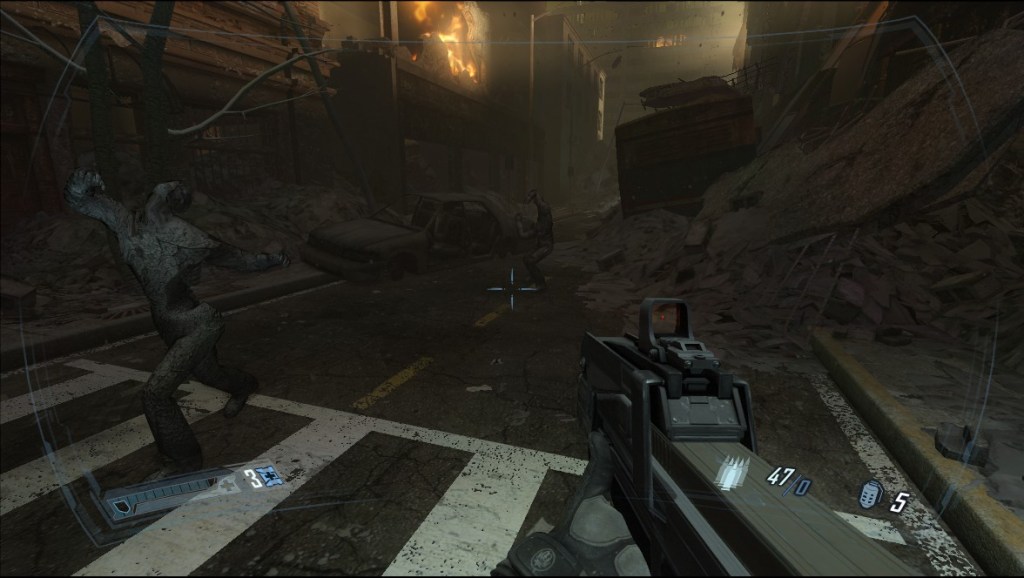
The sequel looks nice for late-2000s gaming, and given the five-year weight, it looks nicer than the original (which is something you hope for).  FEAR 2 is a little less dark (aesthetically) than the original game, but there are still segments of the game where you need to rely on the flashlight.  The flashlight no longer runs out of charge, like in the original, but there are many points where the game will flicker the flashlight (a la your standard ghost film).  As mentioned above, there’s a new HUD that adds a layer of polish to the game and creates an in-game repository for tutorials and lore objects.  As someone who loves picking up nuggets of story, this was in my wheelhouse, but I can imagine some fans of the original might prefer the original’s toned-down approach.

On a final note, I just want to point out that this game follows the same checklist of stages as the original.  You got abandoned/destroyed city blocks (although they are amazing and so much better in the sequel, as the devs could populate a lot of the empty space), a pair of high tech-y facilities, and the classic subway and underground tunnel combo.  There is a level in a very large elementary school that was a fun divergence from the normal FEAR schtick.  All in all, I personally thought the game was a step-up from the original in terms of visuals.

Sound

Not-Mick Foley here plays the important role of nerd comic relief in this game

Par the course when it comes to the sound category for this game.  This is the one ‘meh’ area for me, because there didn’t seem to be anything improved upon from the original here.  I even caught them using tracks for the original (maybe they were remastered or remixed, but it doesn’t change the fact that it was recycling).  Sound effects were all right – I can’t complain too much.  I did miss the vocals from the first game, as the enemies in this game just sound a little less menacing and a little less ‘real’ than the replicants in the first game.  While there were more characters to engage with, the foes felt wooden, even though I preferred the approach to the supernatural foes in this game.

Story (7/10)

The story in this game touches upon some stuff mentioned in the original.  You’re a member of Delta Force (the support group in the original FEAR).  The two expansion packs are, apparently, noncanonical, so we have no clue what happened to the Point Man from the first game.

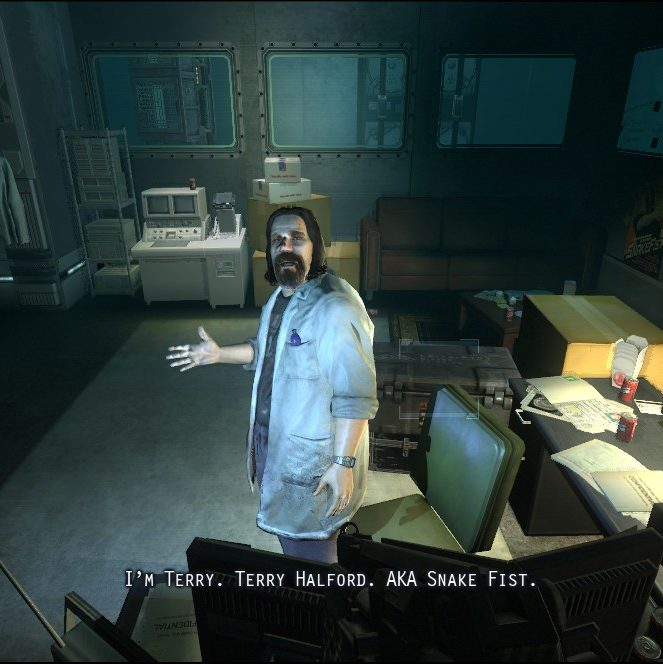
The second game’s silent protagonist is Sergeant Michael Becket (the token jagoff in the group calls him Bucket, which amused me to no end).  He and the squad he’s part of are raiding the residence of Genevieve Aristide, who was mentioned in the first game as a shadowy villain.  The first chapter ends with the same catastrophe at the end of the original game (city go boom for ‘reasons’), and the protagonist wakes up in a medical facility where Aristide and a guy named Snake Fist sound off in the comms to try and get his squadmates to help them. Aristide is being targeted by her own people to cover loose ends.

Yes, this was around the point where the game started to make me feel increasingly uncomfortable …

From there, the plot takes the protagonist on an extended jaunt through the destroyed parts of the city as he chases Aristide, Snake Fist, and a way to deal with Alma.  In standard grim FPS fashion, characters meet varying degrees of gruesome fate as the silent protagonist marches onward, seemingly invincible, to his final destination.  Like the first game, there’s a sassy female solider (Lieutenant Stokes), but in FEAR 2, she takes the role of the deuteragonist.  The ‘out of shape nerd’ trope that was Norman in the first game is filled by ‘Snake Fist’ in the sequel.  New to the game is also your trope of a crewcut-clad military hard-ass, who takes the form of Colonel Vanek.

Spoiler Zone

So the plot this time around sees Becket and his squad as part of Project Harbinger, which is an ATC initiative seeking to train/convert people into psychic commanders like Fettel.  I believe that the people aren’t aware they’re in the program until they’re converted, which happens to the squad after the opening mission, when they are knocked out by the Point Man blowing up the Origin Facility.

After conversion, the squad all get the reflex powers like Point Man, but they also become bigger targets for Alma.  Becket, who lore mentions was one of the stronger candidates (along with his squad mate Keegan), gets tricked by Aristide into entering a TAC chamber, which further amplifies his physic powers, making him a massive target for Alma and the replica soldiers.

The surviving squad mates gradually go bonkers before being taken/killed/ ‘consumed’ by Alma.  A piece of lore mentions that Lieutenant Stokes was a communications officer attached to the squad and not a part of Harbinger, which I imagine meant she wasn’t surgically modified.

Like I mentioned earlier, the game follows similar level layouts to the original.  It also continues the trope of having frequent nightmare/hallucination sequences.  Here, it’s made clear that this is Alma trying to overwhelm the person, with the intent of driving them mad and/or making them susceptible to her ‘consuming’ them.  The game has Alma frequently assail the protagonist, which makes you click the mouse buttons to shake her off – I imagine this would be akin to mashing buttons on a console controller.

After crashing into the subway, Keegan goes loopy and wanders off – Stage B of Alma-in-Head syndrome. Becket gives chase but can’t find him as they eventually make it to the nuclear reactor (also owned by ATC and supposedly abandoned).  Inside, Stokes and Becket activate the machine only to have a wounded Aristide reveal that she wants to use Becket to trap Alma.  Stokes gets shot for protesting this plot, and Aristide seals the psychic chamber with Becket and Alma inside.  A final nightmarish sequence follows where you have to fight off Keegan (who screams about ‘why didn’t she want me’) to throw some switches.

… and by this point it is far too late to escape this glorious horrifying train wreck.

After seeing most of their squad offed in one way or another, Becket, Keegan, Stokes, and Morales head to an elementary school to rescue Snake Fist.  The school, also run by ATC, is a front for experiments on children, and despite murdering everyone in his way, Becket gets to Snake Fist and talks for all of three minutes before assassins kill him.  It is revealed that Snake Fist wants Becket to super charge himself and kill Alma, using a machine at a nuclear station.  Meanwhile, Aristide wants to contain Alma, which Snake Fist believes is nearly impossible.

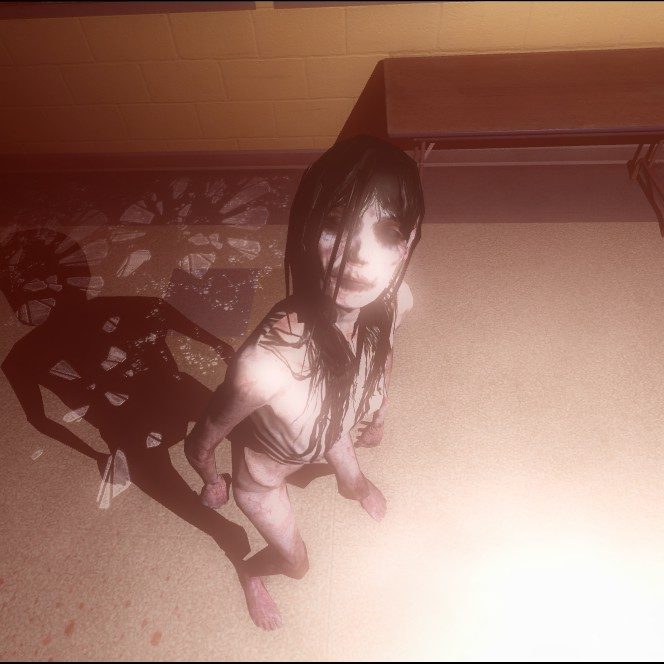
Nevertheless, the final sequence shows a pregnant Alma standing in front of Becket and putting his hand on her stomach.  Sequences during the Becket fight show Alma moaning and some other very suggestive stuff.  So the game ends with the protagonist being strapped into a machine and raped by a ghost (and I thought the first game had some messed up undertones).

Reflection

I think it’s clear that they wanted to make storytelling a bigger part of the experience with the sequel.  After all, there are more characters in the game, and unlike the original, there is at least effort made to give them a little background information (Harbinger files on them), and they at least serve plot devices outside of telling you where to go and dying when appropriate.  I appreciated that they made it a little easier to collect all the lore bits, since this is still an FPS where you only get the skeleton of the plot by gunning and running your way through the various tunnels and derelict scenery.  That said, the skeleton here is more complex than in the sequel, although I imagine that may have come at the cost of streamlining parts of the experience to fit onto the console market.

In the first game, I frequently found myself questioning whether or not I should root against Alma, given her tragic story.  The sequel provides little to move the needle honestly (aside from the bit at the very end, which was mortifying for me).  Characters call her the apocalypse and say she’s a threat, but most of the people labeling her are the same ones that created her.  There’s a line in there about ‘we create our monsters,’ and I think that’s an apt sentiment.  With that, I’m curious to see how the sequel attempts to wrap up the storyline and if there’s any effort made to weave together the two games (the fate of the Point Man is still unknown, given the noncanonically nature of the expansion packs).

There is a DLC for this game, but Steam wanted me to pay 50 dollars for it, and I ain’t got time for that.

Bias/Nostalgia Tint – “Zero free pizzas at an anime convention out of Five”

This game has sat in my Steam library since I got it through one of the earliest Humble Bundles that I purchased.  I booted it up six years ago (and apparently let it run for a day) and never got passed the first sequences.

Overall: B

Playtime

  • 5-6 hours (April 7th to 8th, 2020)

Achievements

  • Game predates achievements