Serious Sam (1st and 2nd Encounters via ‘Serious Sam Fusion 2017 [beta]’)

  • Original Release Dates: March 2001 (First Encounter), February 2002 (Second Encounter)
  • Remake Release Dates: November 2009 (First Encounter), April 2010 (Second Encounter)
  • Developers: Croteam
  • Publisher: Gathering of Developers (Originals), Devolver Digital (Remakes)

Summary
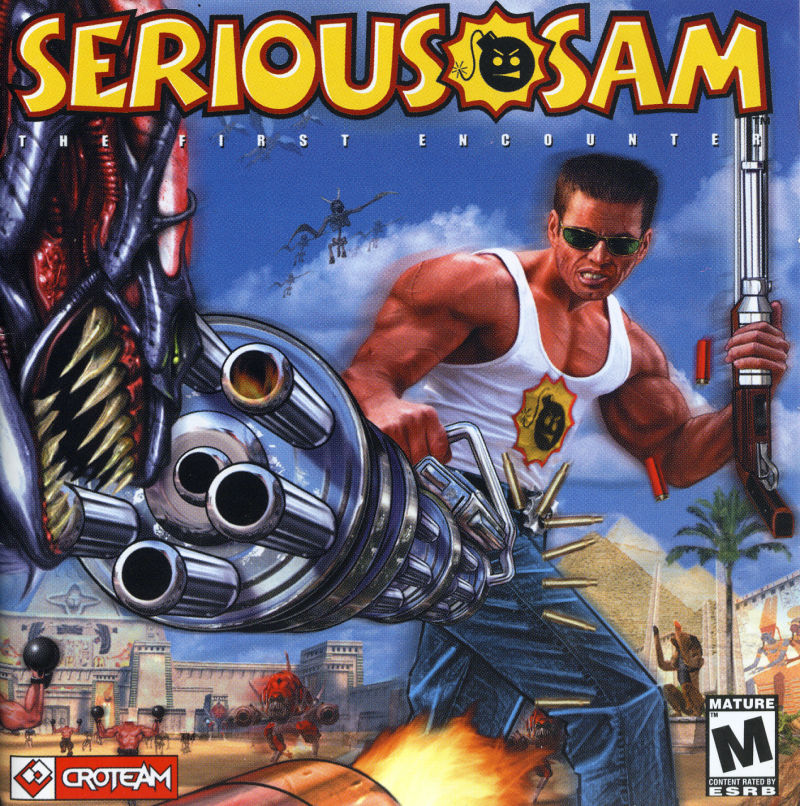
Starring ‘Not Duke Nukem’ ❤

Designed as an independent game over a period of a few years, Serious Sam incorporates elements of all the landmark titles of the almost-3D era of FPS titles into a fully 3D title. If Half-Life (which released a few years before Serious Sam) can be considered a new direction for the genre of shooting games through its emphasis on plot and immersion in a strange world, Serious Sam feels like an evolution of those earliest titles.

Serious Sam is a glorified shooting gallery, albeit with a freedom of movement that wasn’t quite actualized in many of the earlier titles that felt more like rail shooters. Featuring a manly man protagonist who spouts one liners and murders endless waves of alien monsters, Serious Sam tied together a lot of the tropes that made Duke Nukem and Doom mainstays in public culture.

What made ‘the First Encounter’ and its sequel different, however, is the fact that there are clear attempts made to create an immersive world. There are elements of lore, with an AI that provides you (somewhat meaningless) data on the weapons and monsters you find, while also providing you with hints on where to go next and details about your constantly evolving mission. Unlike the cramped corridors of a moon base, Nazi fortress, or a secret, underground science facility, Serious Sam mostly plays out in large, open areas in various historical cities. While the environments are nothing more than that (scenery), they nevertheless provide a stark contrast to the grimy and dark games from which Sam draws most of its inspiration.

Anyone who is a fan of FPS titles should be able to draw some entertainment from the First and Second Encounters. While I personally wish the titles would have been about a third or so shorter than they were, I don’t regret finally sitting down to play through both titles for the first time in close to two decades.

Technical/Presentation (7/10)

Gameplay

Serious Sam is one of the kings of the FPS sub-genre of ‘murder everything with extreme prejudice (and gore)’. In many ways, it is like a three-dimensional version of Contra III or like one of those arcade games where you just spam all the joysticks to try and murder everything on the screen before it can get to you. The game came out in 2001, so I’m not sure it originated anything unique on the 3d FPS stage, as this was a few years removed from landmark FPS titles like Half-Life and Quake and shortly before the genre went full-tilt into war nostalgia with the advent of the Call of Duty and Medal of Honor franchises.
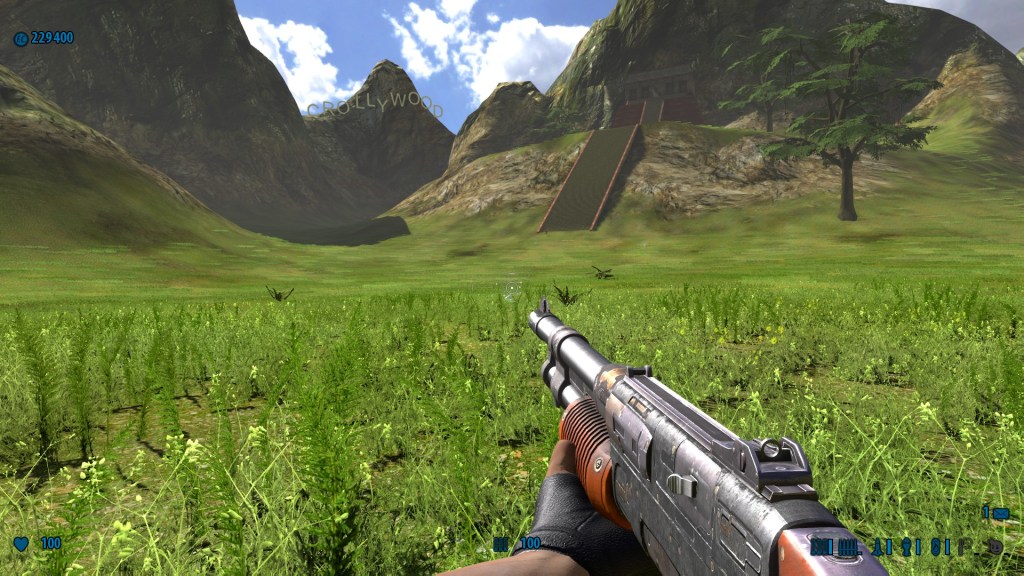
GET IT, ‘CROLLYWOOD’????

One thing worth pointing out that the game has that feels a few years ahead of itself is the in-game AI. NETRICSA is a computer system that’s implanted into soldier’s brains and acts as Sam’s method of translating languages, figuring out where to go, and even providing lore information on weapons, locations, and the various enemies that you murder. It also tracks stats like secrets you’ve found, enemies killed, time taken, etc. While nothing stood out to me about this in the First Encounter, I did notice that the ‘Netty’ blurbs had a lot more personality in the Second Encounter.

The gameplay itself is straightforward. Sam has health and armor, and he has an assortment of weapons that he uses to murder a variety of alien forces. All of your standard FPS weapons are here—pistols (dual wielding, of course), shotguns, machineguns, and rocket launcher.  The First Encounter tops is off with a laser gun and a cannon (a literal cannon that fires literal cannonballs). The Second Encounter fleshes out the assortment further by adding a sniper rifle, flamethrower, and the ‘serious bomb’, which functioned much like the BFG in Doom in the sense that it would murder everything on the screen with extreme prejudice.  The game lets you jump and look up and down (as enemies will come at you from all angles) but concepts like crouching or hiding simply hadn’t been invented yet… plus Sam ain’t that kind of guy. It is worth mentioning, however, that the Second Encounter did have a handful of platforming elements, which did provide a needed wrinkle to the experience.

The Second Encounter adds a handful of powerups that temporarily boost speed, strength, and life, and while there are many (many) secrets that are nestled away throughout both titles, there’s no real incentive to try and track them down.  Like many other FPS titles of the time, most of them are concealed very well, and the lack of any sort of genuine completion bonus renders it moot when you know you really just want to keep running and gunning your way through alien hordes.

Visuals

I played the original version of this game at the time of it’s launch, and for the purpose of this writing, I played the HD remakes that came out in 2009/2010.  I’m also aware that there are VR versions of both titles that released in 2017 but I have no idea what the graphical fidelity might be for those.  In terms of both versions, they match the time period, although I think the original aged pretty well.
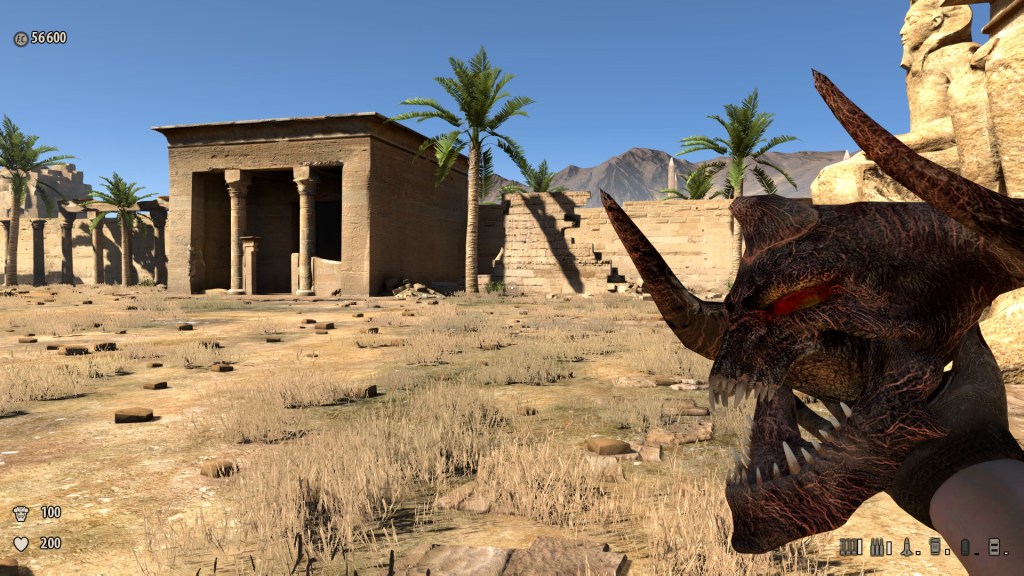
I think this was a Shakespeare reference

For it’s time, I believe Serious Sam was one of the first FPS titles to really provide the player with wide-open worlds, compared to the smaller passages and claustrophobic spaces of earlier titles in the genre. Both the First and Second Encounters do a nice job providing a fun (if nonsensical) backdrop to the action playing out around you, as the set-pieces of Ancient Egypt, Mesoamerica, Babylon, and Medieval Europe give you just enough backdrop without infringing on what you bought the game for (murder).

The effects are also great, as the weapons rip and tear their way through enemies in engrossing fashion. Naturally, the HD remaster can pull off a lot more in this regard, but I did think they could have done a little more. After a while, the static death animations become less amusing, and this was long before most enemies showcased wear and tear.

Sound

The sound in the game is nothing much beyond the tracks that play in the background. Sam is voice acted, but he’s input is relegated to a dozen or two one-liners when you pick up guns or get through a particularly difficult set piece of monsters or platforming. The music itself is up and down, with some titles feeling great and others quickly growing repetitive. I did enjoy the Mesoamerican background music from the Second Encounter, as well as the Christmas-esque music from the snowy subsection of Medieval Europe. There’s a section where the background music is a somber, slow version of Jingle Bells, and every time you enter combat, it ramps up to a heavy metal version of the track.

Story (5/10)

Serious Sam is story-lite in almost every sense of the word. Sam ‘Serious’ Stone is the Earth’s greatest soldier (one who apparently feels zero need to wear visible armor), so he is picked to go on a dangerous mission through time to save the future from an unknown villain named ‘Mental’, whose forces have gradually pushed humanity to extinction.

Sam’s journey starts in Ancient Egypt, where he has to collection various artifacts to find a way to locate and fight Mental. In the Second Encounter, his journey continues in ancient Mesoamerica, ancient Babylon, and into medieval Europe, where he is trying to locate the Holy Grail of legend. Along the way, Sam is confronted by increasingly difficult waves of Mental’s forces, but he manages to slaughter his way through them, including various lieutenants, all while plopping out the contractually obligated one-liners.

Spoiler Zone

It’s difficult to provide anything akin to a spoiler for a game that has very little plot to spoil. Sam is the only character in the game, and he feels like a next gen Duke Nukem in almost every sense of the word (just try and remember a world where Duke Nukem Forever had yet to release). Sam doesn’t have the same flair as Duke, though… at least how I remember Duke. Sam’s quips are few and far between, and while he occasionally makes a reference to some pop culture (whistling Indiana Jones and shouting ‘Goood morning Babylon!’), nothing really zings or lasts. The sole exception to this is a line that stuck with me from my youth, and that’s from the winter zone. Sam exclaims ‘Damn, it’s cold, my nipples are hard like pencil erasers.’ That line made me crack the hell up as a young teenager, and even as a jaded old person, I snickered.

Reflection
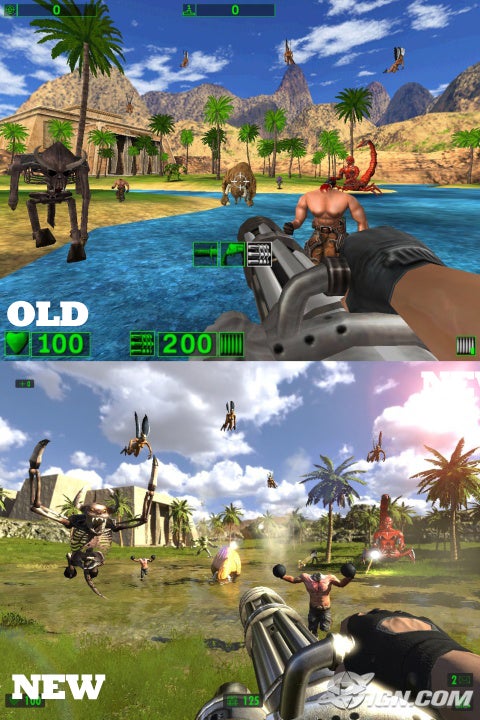
(From IGN) I played the old version as a teen and, yea … the remake is pretty

Serious Sam had slightly more plot than Doom, but there’s not a whole lot to say about the story elements in these first two titles. Yes, they exist, and you do get a degree of world building through the AI in Sam’s brain and the information and quips it provides about the locations, weapons, and monsters. But honestly, I can safely say I never played the game to be engrossed in your standard science-fiction shooter. The fact that it’s transplanted into ancient elements doesn’t really add anything to the plot, because you could have just replaced those backdrops with anything without fundamentally altering the experience. 

The core game doesn’t deviate much from the schtick of ‘kill monsters, progress through mostly linear stage with some frivolous secrets, and located object X, Y, or Z.’ Since the same thing can be said about most prolific FPS titles, I can’t damn the title too much, but this was also around the same time that stuff like Half-Life and Halo were either in the market of close to hitting it, and Serious Sam feels closer to the 90s than the 2000s when it comes to FPS design.

Bias/Nostalgia Tint – “Three pencil erasers out of five.”

I owned this game, and it’s one of the earliest pc games I can remember playing and genuinely enjoying.  I believe it’s one of the earliest Steam purchases I made as well, as I got the whole series as one of the original Humble Bundles (it’s still weird to think this game started out as an indy title).

Overall: C+

Playtime

  • 6 hours (First Encounter)
  • 7 hours (Second Encounter)
  • Time frame: April 15 to 20, 2020

Achievements

  • 28 achievements on one playthrough (About 38% of Fusion’s total achievements)
F.E.A.R. (First Encounter Assault Recon)

  • Original Release Date: October 2005
  • Developer: Monolith Productions
  • Publisher: Vivendi Universal Games, Warner Bros. Games

Summary

FEAR was a game I had in my ‘pc library’ (which was likely a bookshelf or a plastic bin) as a teenager.  I have only the vaguest impressions of playing the game and can’t remember if I finished it (I probably did, I was usually good at that).  In my brain, it’s overshadowed by a few other FPS titles that came out in the same early-to-mid 2000s-time frame, like Max Payne (technically third person but the concepts pervaded the FPS genre enough), Serious Sam, and Metroid Prime.  I regret to inform that I barely touched Half-Life near its original release (non-intentionally).

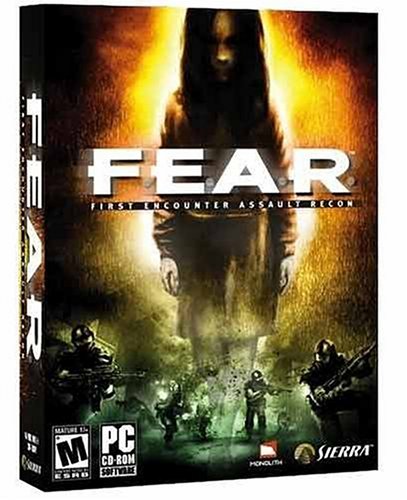
Back when PC games came in layers upon layers of cardboard

FEAR settles very well into the mold of FPS titles in the era between Doom II and the modern era of yearly Call of Duty sequels and party death match titles (not to say there aren’t modern FPS gems).  It’s a shooter game where the emphasis is on reflexes (bullet time is present in a big way) and fighting waves of ‘intelligent’ enemies who duck for cover, lay down suppressing fire, and attempt to coordinate flanking maneuvers.  You’ll die every now and again, for me it was mostly self-caused or from one-shot weapons.  Other than that, it’s not a terribly challenging game on standard difficulty, as weapons, ammo, and armor/health are found to the point where I often found myself with the limit of med packs.

Story-wise, the game also hits the standard tropes of its era.  You’re in an FPS title where the situation starts out seemingly okay before spiraling into chaos and nightmares (a la Half-Life).  You uncover a story about a psychic-controlled army of clones and their commander, who seems to come and go as he pleases.  Later on, you discover links to a mysterious project and a little girl Alma who pops up to spook you as you delve deeper into a very unsettling plot (details below).

All said and done, FEAR is a solid FPS title.  It is a game that didn’t bore me, thanks in part to engaging enemy design and a nice atmosphere of spookiness and solid sound.  I also apologize that I can’t comment on the multiplayer, because anytime I tried to load it up, the game would crash (Clicking ‘Yes’ for ‘Switch to Multiplayer’ caused game crash with no error message).

Technical/Presentation (7/10)

Gameplay

Your standard FPS from the post-Matrix era.  That is to say, you rely a lot on bullet time to seamlessly navigate the game’s harder challenges.  In game, they refer to this as ‘reflexes’.  Other than that, this is an FPS game where you are inventory limited.  You can carry three weapons at a time, but it’s pretty easy to swap on the go or even during longer combat sequences.  I was a fan of dual pistols.  The expansion packs add some heftier weapons, like a lightning gun and a grenade launcher, but aside from that, it’s standard fare (pistol, shotgun, sniper rifle, and a few variations of machine guns/assault rifles).  Explosives are present, and you can melee opponents (there’s even a jumping kick thing that I rarely used). 

Controls were fine for me, and I only have minimal complain much here.  Run through the stage and kill what’s in your way.  Along the way, you can collect powerups for health and the reflexes bar.  My only issue was the placement of some buttons, particularly having the flashlight and first aid on the z and x buttons.  It made it a bit hard to press them while maneuver in combat, and I occasionally pressed g, which switches you to some kind of melee. There’s also little bits of story, and it’ll occasionally break up the pacing with horror vignettes (sometimes just a quick scare and other times taking up chunks of an interval).  The end of each episodes often delves into horror fare, with the enemies being ghosts and ghouls of various threat levels.  No boss fights, but you’ll have to occasionally battle very strong enemies to progress.

One thing to highlight here that was a hallmark and selling point at the time is the enemy AI.  At the time of the game’s release, the enemies were touted for being highlight advanced.  The enemies frequently communicate with one another and even go so far as to layout strategies like suppressing fire and use of grenades.  Enemies will duck into cover (research told me this was novel at the time) and even try to flank the protagonist.  Larger enemies, like the mechs that occasionally appear as pseudo-bosses, ignore this and tend to head straight at the character or even just standstill and fire.  The AI does make the game more enjoyable, because you can get the drop on enemies and even attempt to disengage and reengage at various points.

Visuals

This game is still very kind to the eyes for its age.  I was able to smoothly run it at high graphics settings as the difference between high and max wasn’t really enough to make me want to sacrifice a few more frames.  By modern standards, I still think the game looks pleasant, as there was very little blockiness.  The lighting was never an issue to me, either. 

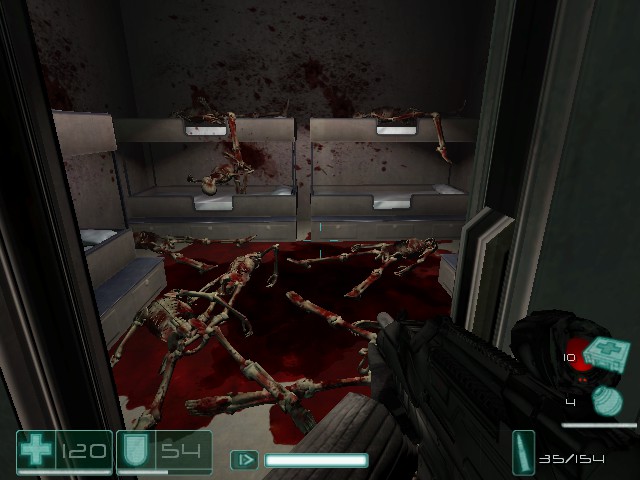
As a brooding teenager there were few things that I found more metal than a room full of pixelated and/or polygonal corpse bits with bloody smears everywhere

The one big knock I can think of in this regard is the fact that it feels like there’s a lot of recycling of assets across the base game and expansion packs.  It felt like, across the three scenarios, you always had some sort of abandoned building, a lab-type facility, subway tunnels, and street blocks.  This isn’t saying it was verbatim the same maps, but the visuals felt very similar.  There’s a variety of different troop types, but I think it caps out at maybe 3 or 4 per faction.  Also, the game lacks any sort of progression in terms of enemy damage, although that may be a limitation of the time.

Sound

I have to say, I loved the sound throughout the three episodes.  I’m accustomed to the standard riggermarole of heavy metal or heavy industrial tracks that are fairly common in 2000s and late 90s FPS titles.  What I liked about FEAR is that there’s a high amount of variety in the soundtracks that play when you’re in combat.  In Extraction Point, they started busting out what I can only describe as a tense kind of tribal music.  Maybe that’s the wrong way to explain it, but I really enjoyed that track.  The ambiance was done well, especially with the intermittent ‘horror/scare’ scenes and the music and sounds employed there.

Story (6/10)

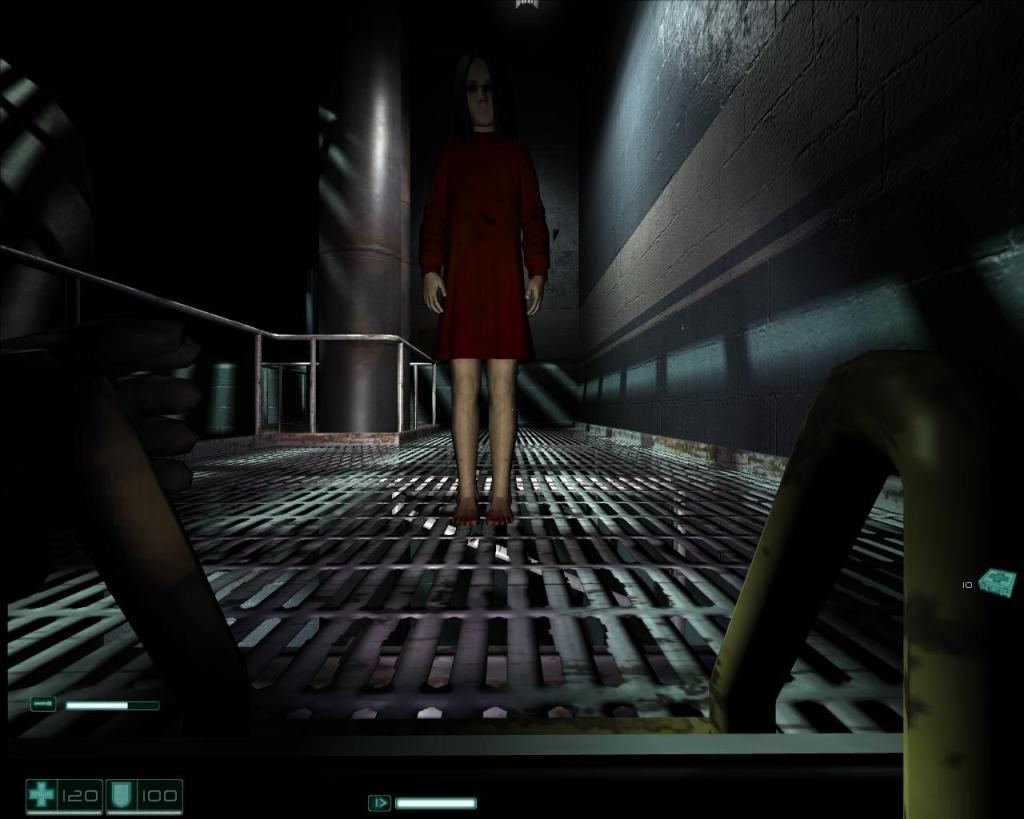
(Not my screenshot) The game, and its spooky ghost girl, will have anyone recalling mid-aughts J-horror.

I feel like most FPS titles fall into one of two categories:  Story-focused or Story-lite.  The former would be your Bioshocks or your Max Paynes, where there’s a lot of story and dialogue to digest and process as you one-man-army your way through a horde of people or monsters.  FEAR is story-lite.  Yes, you have supporting characters and there are scenes that play out through the game’s engine, but aside from that, it doesn’t feel like it’s the focus.  You’ll discover the core of the story by playing the game and being told the story through the other characters, particularly Paxston Fettel (the antagonist, kind of) and Rowdy Betters (your boss).  As you murder your way through a variety of settings, you can learn more by listening to voicemails on landlines (press F to pay respects) and hacking into laptops.

The protagonist in the game is your standard FPS protagonist—silent and faceless—and referred to as the ‘Point Man.’  In the expansion packs, you continue the Point Man’s story (Extraction Point) and also play another operative (the Sergeant) on a secondary FEAR mission that is concurrent with the base game and Extraction Point.  Supporting characters include the other two members of the FEAR squads, the Wade’s, an obese tech worker, and Delta Force (of which a few named people support across all three episodes). 

Spoiler Zone

The plot sees an unhinged Fettel controlling an army of replicants to besiege the headquarters of the company who created said replicants (Armachan Technology Corporation, ATC).  The FEAR squad is sent in to kill Fettel, but the situation goes sour when one member of the squad vanishes (Jankowski) and another (Jin) is injured.  The Point Man presses on to pursue Fettel, and along the way, he starts to hallucinate a some nightmare fuel (ghosts, ghouls – your standard bloody schlock).  Fettel appears and disappears at will.  A little girl in a red dress pops up.  The Point Man hallucinates about a corridor in a hospital. 

You eventually discover that Fettel is the son of Alma, who was a powerful psychic and was supposed to be the way that ATC would coordinate their army of replicas.  At some point in the past, there was a ‘Synchronicity Event’ where Alma reached out to a young Fettel and had him murder some people.  ATC tries to cover up what they did, but the Point Man pushes on to an underground facility where Alma is supposedly in stasis.  You find out that Harlan Wade, father of Alice Wade (who you rescue in an earlier mission), plans to release Alma.  He’s also her dad, but she repays him with murder.  Alice and Fettel are also killed, and the Point Man rushes to escape.

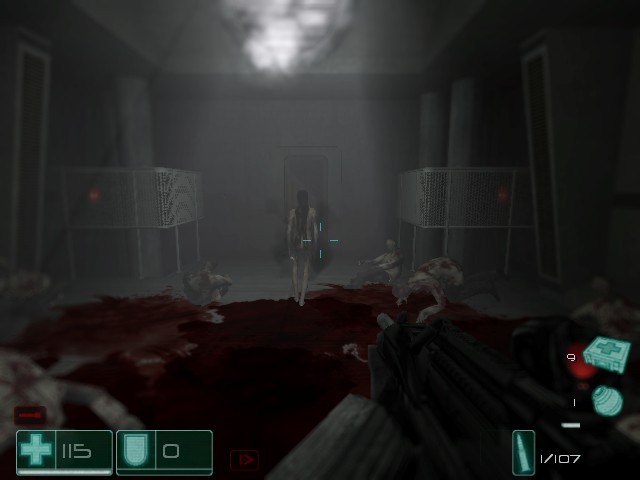
In Extraction Point, you continue as the Point Man.  Alma chases you (appearing as both the little girl and as a naked woman with long, black hair).  Grownup Alma is a clear cash-in on the horror movie scene of the mid-2000s, with her look seeing straight out of a Japanese horror film.  Picking up from the explosion of the facility, Extraction Point has the Point Man escaping the blast only to get separated from Jin and Delta Force’s Doug Holiday.  Fettel is also back (for reasons he doesn’t seem to understand).  Both Doug and Jin die along the way, which takes the Point Man through the city, an industrial district, a subway, and finally to a hospital.  At the end, the Point Man tries to escape only for Fettel to sabotage the helicopter, and the Point Man survives and watches the city continue to burn.

In Perseus Mandate, you control a member of a second FEAR squad.  This game features another faction (mercenaries called the Nightcrawlers) and has a lot more use of allied helpers.  There’s also a spooky Senator trying to coordinate a coverup, much like ATC in the base game.  The FEAR squad in Mandate finds themselves at another ATC compound, where they discover much of the same information as the base game.  Surviving the run-in at the research facility, the FEAR Sergeant finds himself running from the explosion (the facility in the base game exploding) and landing in the subway tunnels.  He makes his way to yet another ATC Facility, where the Nightcrawlers are after Alma’s DNA.  Experiencing hallucinations much like the Point Man, the Sergeant battles an army of mercenaries, replicants, and ATC security to recover Alma’s DNA and escape.

Reflection

The core story, when you shed aside all the bullets and nonsense, is that of “Physic child murderer and the people who want to take advantage of her.”  Now, the extra stuff is what makes this really garish the more I think about it, as I’m fairly certain that Harlan Wade states at some point that they like, impregnate Alma multiple times while she was comatose and then sealed her back up after she gave birth.  Given the ages, I’m guessing she was a teenager when they did this, and the fact that her father was part of all of this only adds to the unsettling nature of this story.  They mention that they took her off life support and she died, so I found myself wondering if it was all just psychic manifestations.  Yet, she gets ‘released’ at the end of the game, so I imagine there had to be something sealed away inside that vault (a psychic spirit?).  That would seem to tie into the fact that the scary/supernatural stuff in the games is often prefaced by white noise on the radio (another tie-in to Japanese horror, if I’m not mistaken). 

Having said ALL that, I don’t really know how much I can fault the killer super child for wanting to murder everyone, since even her own dad used and abused her from the earlies age possible.  If anything, Alma comes across as a Frankenstein-type villain where you can’t really fault them.  We all cheered for the Bride in those Kill Bill films when she murdered everyone.  Alma (or whatever ghost, physic phantom, scifi-trope she has become) just wants some of that too.

Bias/Nostalgia Tint – “One misunderstood ghost monster out of Five”

I owned the base game as a kid.  I remember buying it at Walmart back when physical copies of PC games were a thing.  It came in one of those lovely carboard boxes with a bunch of discs.  That said, I remembered nothing of the game, outside of ‘spooky little girl’, so I can safely say I probably had very little intentional bias. (Alex from 2021: ‘Misunderstood ghost monster’ does NOT age well)

Overall: B-

Playtime

  • F.E.A.R – 8 hours (April 1 to 3, 2020)
  • Extraction Point – 4 hours (April 4, 2020)
  • Perseus Mandate – 3 hours (April 6, 2020)

Achievements

  • Game predates achievements